Why We Built the AI That Governs Itself
Most enterprise AI deployments fail not because the models are bad, but because nothing governs them. VDF co-founder Suha Selcuk explains the design decision behind SEEMR — the self-evolving operating layer that learns to route AI work while keeping hard policy boundaries intact.
I want to tell you about a conversation I keep having.
It goes like this: a CTO or IT director has deployed AI tools across their organisation. Usage is up. People are excited. Then, three months in, a bill lands. It’s three times what anyone projected. Or a model was used for a regulated workflow that it was never approved for. Or the knowledge assistant started hallucinating because the knowledge graph it was pulling from hadn’t been updated in two months.
Every one of these stories ends the same way: someone pointing at the AI and asking, “why did it do that?”
The honest answer is almost always: because nothing was governing it.
The problem we kept running into
When we started building VDF AI Networks, we believed — as most people in this space do — that the hard problem was model capability. Make the model smart enough and everything else follows.
That belief evaporates quickly when you spend time with enterprise teams actually deploying AI at scale.
The models are not the problem. The models are remarkably good. The problem is the layer between the models and the organisation: how work gets routed to the right model, how knowledge stays current, how costs are controlled, how compliance is maintained, and — critically — how any of this gets better over time without someone manually tuning it every week.
We watched organisations build this layer out of spreadsheets and meeting notes and tribal knowledge. We watched it break as soon as the number of models, agents, and tools exceeded what any one person could hold in their head. We watched teams freeze their deployments rather than risk a compliance incident, or overpay for the heaviest model on every task because they had no way to reason about what “right-sized” even meant for their workload.
The governance problem was not a configuration problem. It was an architecture problem.
What we tried first — and why it didn’t work
Our first instinct was the obvious one: give administrators a policy interface. Define what models are allowed, what tools can be invoked, what rate limits apply, and enforce it.
That worked. Right up until the moment it needed to change.
Because here is what static policies cannot do: they cannot learn that a particular domain consistently gets better results from a reasoning-first model. They cannot notice that a specific tool is timing out more than it should and route around it. They cannot observe that energy consumption spikes on Tuesday afternoons because of a specific workflow pattern and quietly shift execution toward more efficient models before anyone raises an alarm.
Static policy enforcement answers the question “is this allowed?” It has no answer for “is this optimal?” And in production AI workloads, the gap between allowed and optimal is where most of the cost, latency, and quality problems live.
We needed governance that could learn. But we had seen enough enterprise AI disasters to know that learning systems without hard constraints are dangerous. You cannot have a model routing system that “learns” its way around a compliance boundary. You cannot have an agent that “optimises” its way into invoking a tool that was explicitly blocked.
The design challenge was specific: build a system that gets smarter over time, but that cannot learn its way past the rules that matter most.
The architecture we arrived at
We spent a long time on this. The solution we landed on separates two things that most systems treat as one.
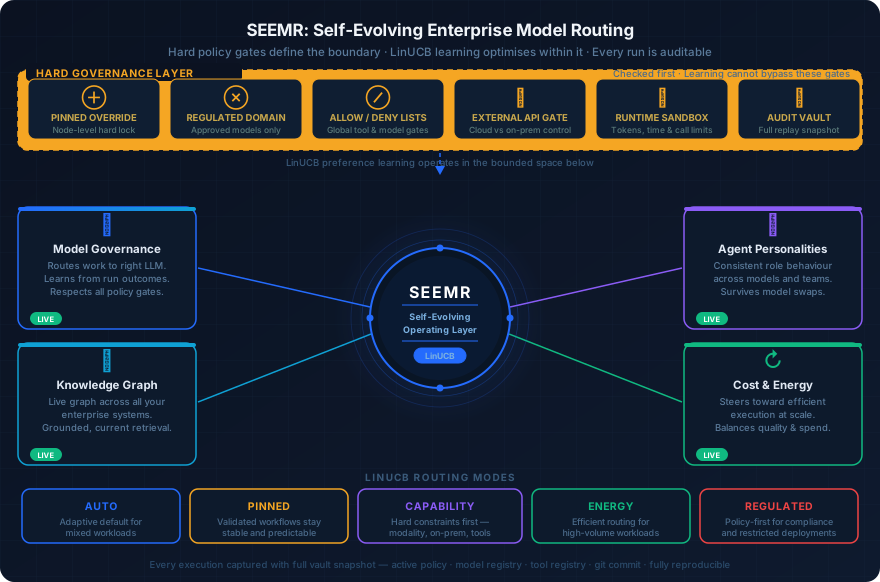
Hard policy gates are immutable. They are checked first, before any learning or optimisation runs. If a model is on the denylist, it is never selected — not by a human, not by the learning system. If a tool is blocked, it is blocked. If a domain is regulated and requires approved models only, that constraint is enforced regardless of what the routing algorithm has learned to prefer. These gates do not negotiate. They do not get tuned. They are the floor.
Preference learning operates within the space the hard gates leave open. Once the policy has defined what is allowed, the system uses a multi-armed bandit approach — specifically LinUCB, a contextual bandit algorithm — to learn which choices within that space produce the best outcomes. Better quality. Lower latency. Lower cost. More efficient energy use. The system observes every run, captures the outcome, and updates its routing preferences continuously.
This is the architecture that became SEEMR: a self-evolving operating layer that coordinates model selection, tool selection, and workflow adaptation across enterprise constraints.
What SEEMR actually does
There are four dimensions that SEEMR manages today in production.
Model Governance handles which model gets selected for each node in a workflow. It respects pinned overrides (when a workflow has been validated and should not deviate), regulated domain restrictions (when compliance requires approved models only), and explicit allow/deny lists — and then, within those constraints, it learns from run outcomes to improve routing quality continuously.
Agent Personalities keep role-specific behaviour consistent across teams, use cases, and operating environments. When you deploy an agent for engineering triage and another for legal review, SEEMR maintains the behavioral consistency of each across different models and tool configurations.
Knowledge Graph connects entities, context, and provenance across the fragmented systems that every enterprise actually runs on. Drive, Jira, Confluence, GitHub, Slack — the knowledge that matters to your AI is scattered across all of them. SEEMR maintains a live, connected graph so retrieval stays grounded in current organisational reality rather than a snapshot from six months ago.
Cost and Energy Optimisation steers execution toward more efficient choices when scale and operational footprint matter. This is not about cutting corners. It is about routing a summarisation task to a model that is genuinely good at summarisation and costs a fraction of the price, rather than defaulting to the heaviest available model because nobody has thought about it.
Five routing modes — Auto, Pinned, Capability, Energy, and Regulated — give teams precise control over how the learning layer behaves for each workload type.
What it means to be auditable by design
One thing we were not willing to compromise on: every decision the system makes must be reproducible.
SEEMR captures a full vault snapshot at execution time: the active policy, the model registry, the tool registry, the knowledge graph state, and the git commit of the running code. If something unexpected happens in a regulated workflow six months from now, we can reconstruct exactly what policy was active, which models were available, what the system chose, and why.
This matters enormously for regulated industries. “The AI did it” is not an acceptable answer in healthcare, financial services, or legal contexts. “The AI did it, here is the exact policy that governed the run, here is the model that was selected, here is why it was within compliance scope” — that is an answer that an audit can work with.
Why this is the right moment
I want to be direct about something: we did not build SEEMR because it was technically interesting, though it is. We built it because every organisation we spoke to was solving this problem badly, manually, or not at all.
The transition from experimental AI to operational AI is not a model problem. It is a governance, reliability, and cost problem. The teams that are winning right now are not the teams with access to the best models — almost everyone has access to the same models. They are the teams that have figured out how to route work intelligently, maintain governance under scale, keep knowledge current, and learn from every run rather than starting over each time.
That is the problem SEEMR is designed to solve.
Where to go from here
This post is necessarily high-level. The architecture behind SEEMR — the LinUCB routing modes, how the knowledge graph handles provenance across fragmented systems, how the policy layers interact, how the replay contract works in regulated deployments — is worth understanding in detail if you are evaluating AI infrastructure for your organisation.
We have built a full deep-dive on the SEEMR architecture page. It covers the four live dimensions, the five routing modes, how learning stays bounded by policy, what observability looks like in production, and what we are building next.
Explore the SEEMR architecture →
If you would prefer to talk through how this applies to your specific deployment constraints, we are also happy to walk you through it directly.
The question we are trying to answer is simple: how do you run AI at enterprise scale without losing control of it? We think we have a good answer. We would like to show you.