PLAYBOOK · HEALTHCARE
Build an on-prem health insurance rule checker with VDF AI.
Health insurers, TPAs, and payer-provider networks operate on dense, fast-changing rule sets: medical necessity, plan benefits, prior authorization, exclusion clauses, fraud and waste indicators. This playbook shows how to construct a regulator-grade rule checker on VDF AI — using a Custom API, intent templates, and carefully crafted system prompts — that runs entirely inside your network, with every decision traceable.
The problem
Rule books grow faster than IT can ship
Claim adjudication, medical necessity, and plan benefit rules change every quarter. Hand-coding them into legacy decisioning systems is slow, error-prone, and opaque to regulators. SaaS AI vendors can't see protected health information, and shipping PHI to a public API is rarely an option.
- Hundreds of policy variants per insurer
- Frequent CMS, EU, or local regulator updates
- Audit trails required for every adjudication
- Strict residency and PHI handling rules
The VDF AI approach
A composable, on-prem rule-checking network
You bring your rule set, your plan documents, and your claims schema. VDF AI gives you a Custom API, an intent template, agent definitions, and a Network that ties them together — all running on your hardware, governed by SEEMR.
- Custom HTTP tool to call your internal rule engine
- Intent templates for adjudication, exclusion, and prior auth
- System prompts tuned per plan family
- Full traceability via Live Execution Monitoring
REFERENCE ARCHITECTURE
How the rule checker is wired
HL7, FHIR, PDFs, SQL
EDA · Feature Lists · pgvector
Plan benefits · Exclusions · CMS guidance
POST /rules/check
System prompt + tool calls
Intent template · SEEMR routing
PLAYBOOK · STEP BY STEP
From rule book to governed adjudication network
Register your rule engine as a Custom HTTP Tool
From AgentsHub → Tools, click Add HTTP Tool. Point it at your internal endpoint (for example POST /rules/check) and declare its JSON schema so the agent can call it safely.
{
  "tool_name": "health_rule_check",
  "endpoint_url": "https://rules.internal/v1/check",
  "http_method": "POST",
  "auth_method": "bearer_passthrough",
  "parameters_schema": {
    "type": "object",
    "properties": {
      "plan_id":    { "type": "string" },
      "claim":      { "type": "object" },
      "context":    { "type": "object" }
    },
    "required": ["plan_id", "claim"]
  }
}
VDF AI stores the tool in tool_catalog with tool_type='http' and merges it into the agent catalog — visible only to the owner or to your domain.
Define an Intent Template for "adjudicate-claim"
Intent templates teach Networks v3 how to decompose a request. For adjudication, the template names the sub-intents (eligibility, medical necessity, plan benefit lookup, exclusion check, fraud signal) and the tools each sub-intent is allowed to call.
- Eligibility →
member_lookup+policy_status - Medical necessity →
health_rule_check+ RAG of clinical guidance - Exclusion → RAG of plan documents + structured exclusion lookup
- Fraud signal → vector search on prior denials
Author the System Prompt for the Rule Checker Agent
The system prompt encodes how the agent must reason, justify, and cite. Keep it deterministic and auditable.
You are a Health Insurance Rule Checker.
Always:
 - Quote the plan clause and CMS reference verbatim.
 - Call health_rule_check before producing a decision.
 - Return JSON: {decision, reason, citations[], confidence}.
Never:
 - Speculate beyond the rule set.
- Reveal PHI outside the requested fields.Vectorize plan documents and CMS guidance with VDF Data
Use VDF Data's Vector DB Builder to chunk and embed plan booklets, schedules of benefits, and regulator guidance into a pgvector index. Bind that index as a rag_vector_query tool inside the Network.
Compose the Network and let SEEMR govern routing
In Network Labs, drop the Rule Checker Agent, the RAG retriever, and the Custom HTTP Tool onto the canvas. Bind them to the adjudicate-claim intent template. SEEMR then governs which model handles which sub-intent — high-stakes adjudication on your private high-capability model, retrieval on a small, energy-efficient SLM.
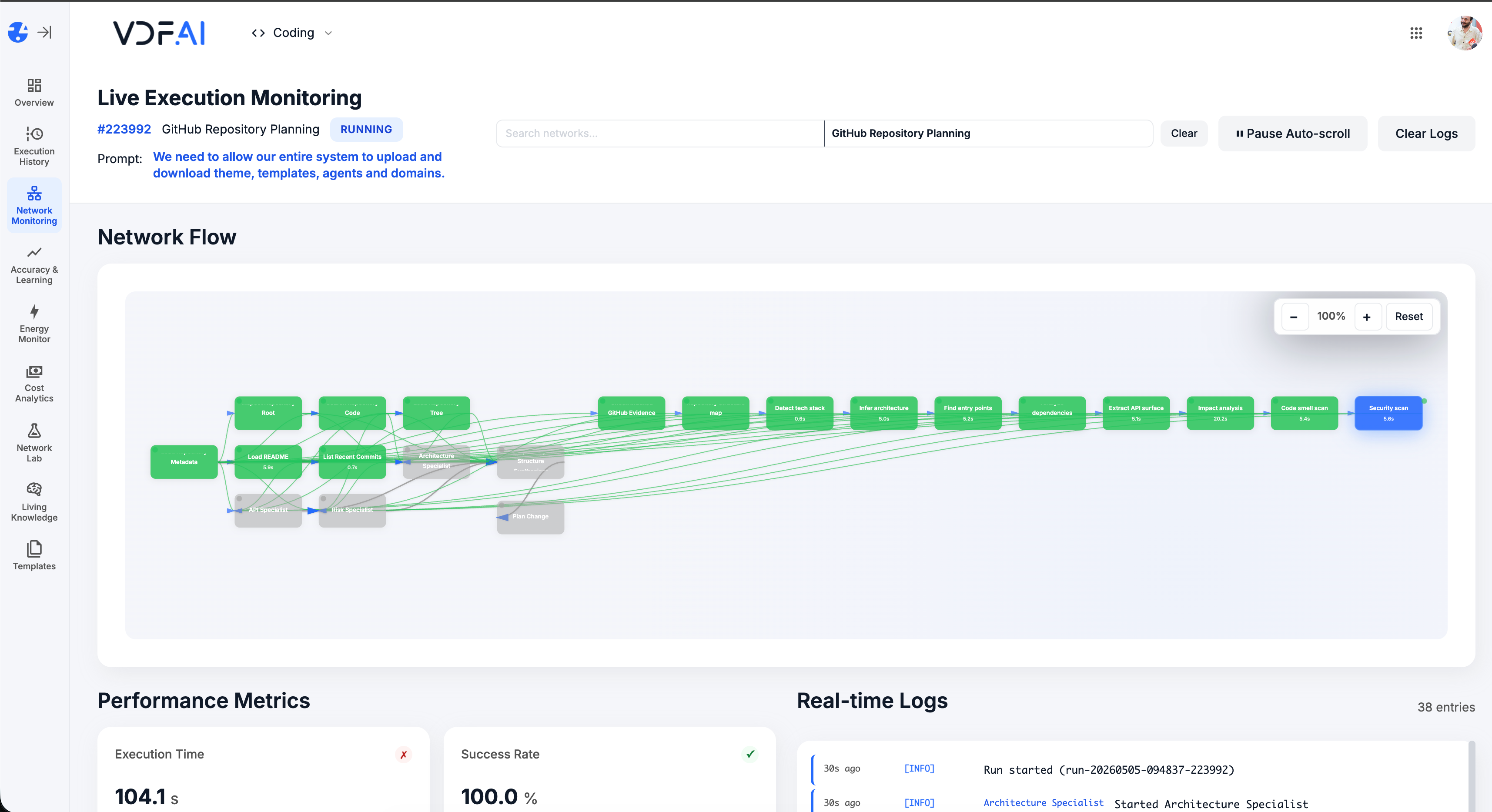
Monitor every adjudication in Live Execution Monitoring
Every claim flows through Network Flow with timing, success rate, and per-node logs visible in real time. Reviewers can pause auto-scroll, replay a run, or escalate to a human.
BUSINESS OUTCOMES
What changes once the rule checker is live
faster first-pass adjudication on routine claims, with no PHI leaving the network.
of decisions carry plan-clause citations and rule-engine evidence — ready for any audit.
energy reduction via SEEMR routing routine sub-intents to small private models.
SELF-EVOLVING GOVERNANCE
SEEMR keeps the rule checker honest as plans evolve
Every adjudication run is a signal. SEEMR's Model Governance and Knowledge Graph learning modes re-balance which model handles which sub-intent, expose drift on plan amendments, and protect cost and energy ceilings.


GET IN TOUCH
You Have Questions
Tell us what you’re trying to achieve—governed AI Networks, enterprise RAG, deep integrations, or on‑premise deployment. We’ll help you map the right architecture, security posture, and rollout path. If you’re moving beyond AI pilots and need scalable, auditable execution, reach out—our team is ready to help.