Sovereignty is non-negotiable
Citizen data and mission information must remain under national and organizational control, ruling out foreign or shared-cloud AI processing.
EXECUTIVE BRIEF · GOVERNMENT & PUBLIC SECTOR
Government and defense organizations need AI that respects sovereignty, classification, and public accountability. Fully on-premises and air-gapped deployment lets agencies adopt AI agents without sending citizen or mission data to any external cloud.
For agency CIOs, CISOs, digital transformation leads, and security officers in government and defense.
The public-sector edition as a print-ready PDF — sovereignty position, accreditation path, and first workflows, ready for a security review pack.
The pressure
Citizen data and mission information must remain under national and organizational control, ruling out foreign or shared-cloud AI processing.
Many workflows run in air-gapped or segmented networks where hosted AI simply cannot operate.
Every AI-assisted decision must be explainable and auditable to oversight bodies and the public.
Defense and intelligence workflows require platforms that run with no outbound connectivity, accept offline model artifacts, and produce explainable audit evidence without cloud telemetry.
Why on-premises
On-Prem Sovereign AI for Government & Defense
A fully on-premises, optionally air-gapped platform keeps data and models under sovereign control, operates inside classified and OT networks, and produces the complete audit trail that public accountability demands. Agencies get modern AI without compromising sovereignty or security posture.
Compliance mapping
All data and models remain within national and organizational control; no external egress.
Network-isolated deployment and logging map to incident-handling and resilience obligations.
Transparency, human-oversight, and documentation controls for public-sector high-risk use.
Systems & data
First workflows
First workflows for deploying sovereign, air-gapped AI in government and defense.
Agents draft responses and summarize case files grounded in internal records, accelerating citizen services under full audit.
Private retrieval over statutes, guidance, and internal policy gives officials grounded, cited answers inside the perimeter.
Agents assist with reviewing, classifying, and preparing documents for release while sensitive content stays controlled.
In air-gapped environments, agents help analysts synthesize internal sources without any external connectivity.
The first 90 days
Deploy into the target enclave and run the security assessment against the platform itself — network posture, offline update path, logging, and access control. Doing this before any workflow means later services inherit the accreditation instead of repeating it.
Exit criteriaSecurity assessment complete for the deployment pattern, including the offline artifact process.
Start with statutory guidance and internal policy. Officials get cited answers with the source paragraph visible, and the gaps surfaced by unanswerable questions become a documentation backlog worth having.
Exit criteriaA live Q&A service over a defined corpus, with provenance visible on every answer.
Move to correspondence and casework drafting, where an official reviews and owns every output. Capture the review decisions themselves — they become the evidence base for future oversight questions about how AI was used.
Exit criteriaAssisted casework in one team, with an explainability record suitable for an oversight response.
The cost model
Public-sector AI budgets are scrutinised on a different axis than commercial ones: unit cost matters less than predictability, auditability, and the ability to defend the spend to an oversight body. A metered inference bill that moves with citizen demand is difficult to defend in an annual estimate — and impossible to cap without capping the service.
Casework volume spikes with policy changes and public events. Fixed platform capacity absorbs those spikes without a budget variance to explain.
Security accreditation of an on-prem platform is a one-time investment that subsequent workflows inherit, instead of a new third-party assessment per service.
Adding or replacing a model inside an accredited boundary is a change-control task, not a fresh commercial and security process.
Compare the two models in detail: committed flat pricing vs. pay-as-you-go.
Proof points
A government agency deployed air-gapped policy Q&A for casework teams. Officials received cited answers from internal statute libraries with no citizen data egress — satisfying both security review and parliamentary oversight requests.
A defense organization ran document classification agents inside a segmented network. Sensitive material never crossed the air gap, and analysts retained full provenance logs for classification decisions.
Objections
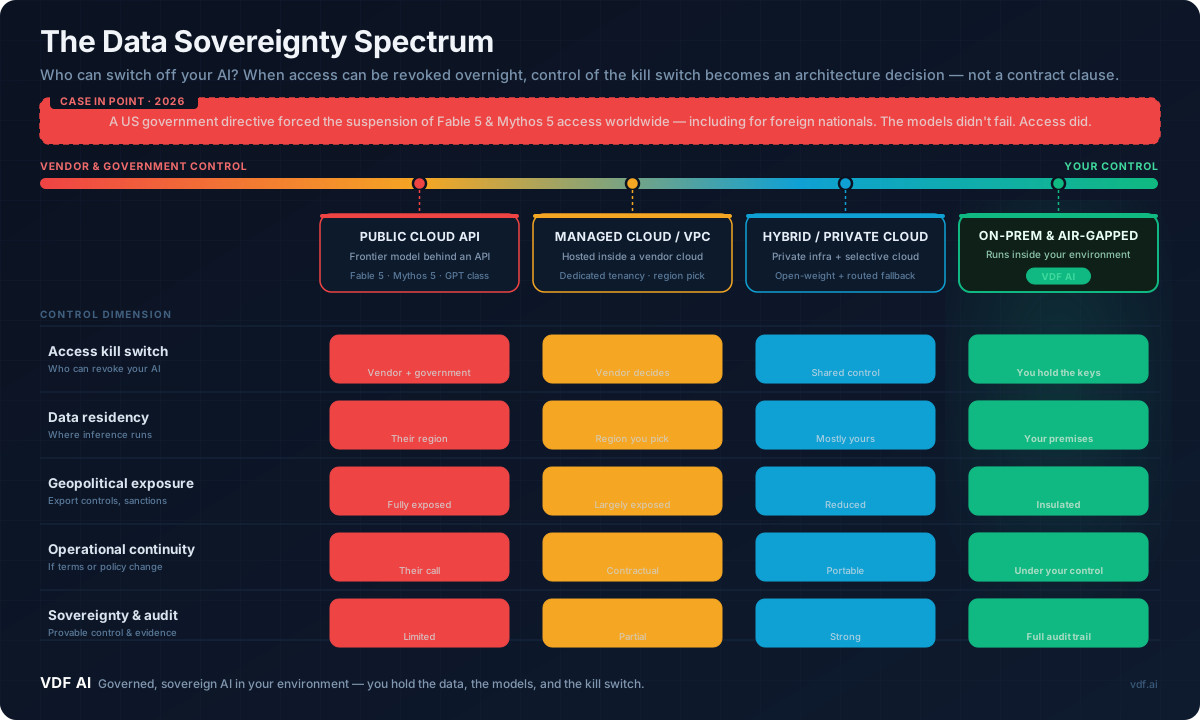
Regional hosting addresses data residency, not jurisdictional control. Where the concern is compulsion, foreign ownership, or continuity of service under geopolitical stress, only infrastructure operated by the agency or a domestic partner resolves it.
Model and platform updates ship as signed offline artifacts moved through your existing transfer process, on your cadence. Agencies already run this pattern for operating systems and threat intelligence; AI models are one more artifact class.
You can explain assisted work if the system records what was retrieved, what was generated, and who accepted it. The platform is designed to produce that record by default, which is why advisory and drafting workflows clear review before autonomous ones.
Evaluation checklist
The full procurement version: Enterprise AI Agent RFP Checklist · On-Prem AI Reference Architecture
Questions
Yes. The complete platform — orchestration, routing, retrieval, and models — runs with no outbound internet access. Updates and models are delivered through a controlled offline artifact process.
Entirely. All processing and inference happen inside your perimeter on infrastructure you control; nothing is sent to an external provider.
Private cloud endpoints still process data on vendor-controlled infrastructure, often in foreign jurisdictions. Sovereign on-prem AI keeps the entire inference and retrieval path on infrastructure you operate and certify — the standard for classified and citizen-data workloads.
The platform logs every retrieval, model call, and output. Combined with human-oversight gates, that evidence supports EU AI Act documentation and public-sector explainability requirements.
Policy and legislation Q&A or casework drafting: contained knowledge bases, immediate staff value, and audit evidence that satisfies security and oversight reviewers.
Installation is measured in days; the schedule is set by security assessment and the offline artifact process. Agencies that accredit the platform pattern before scoping a workflow typically reach a live internal service within a quarter, because every subsequent service inherits that accreditation instead of restarting it.
The briefing
For Government & Public Sector, we walk your security, risk, and platform leads through the deployment model, the compliance position, and the first workflow worth funding. Three things we cover:
Where data, models, and operations sit, and what that means for compulsion, continuity, and procurement policy.
The network pattern, offline update process, and logging design for your classification level.
One workflow scoped with your team, including the explainability record it produces.