The pressure forcing the decision
The regulatory, data-residency, and cost dynamics pushing leaders in your industry to act on AI now — and why the usual hosted options fall short.
Executive briefs
Short, decision-grade briefs for leaders in regulated industries. Each one covers the pressure forcing the AI decision, why on-premises deployment is the answer, how it maps to your compliance obligations, what it costs, and the first workflows that pay back — written to be handed to your security and risk teams.
Why these briefs exist
Leaders in banking, government, healthcare, energy, and telecom are under pressure to adopt AI while protecting regulated data and satisfying supervisors. Generic, hosted AI tools send your most sensitive data to a third party — a non-starter under DORA, GDPR, HIPAA, NIS2, and the EU AI Act. These briefs make the alternative concrete: private, on-premises AI agents that keep data, models, and audit trails inside your perimeter, so you can move fast on high-value workflows without ceding control or failing an audit.
The library
DORA-ready, on-prem AI for banks and financial institutions.
Sovereign, air-gapped AI for agencies and defense.
HIPAA-aligned, on-prem AI that never exposes PHI.
NIS2-aligned, network-isolated AI for essential services.
NIS2-aligned, on-prem AI for carriers at scale.
Tell us your environment and constraints — we will point you to the right brief and the right first workflow.
Request a briefingWhat every brief covers
Every brief follows the same structure, so you can compare across industries and hand the relevant one to the right stakeholder.
The regulatory, data-residency, and cost dynamics pushing leaders in your industry to act on AI now — and why the usual hosted options fall short.
The case for keeping data, models, and audit trails inside your perimeter, written for security, risk, and compliance stakeholders — not just engineers.
How private deployment maps to the frameworks you answer to — DORA, GDPR, HIPAA, NIS2, the EU AI Act, and data-sovereignty obligations.
High-value, low-risk workflows to start with, chosen so you prove the platform quickly while sensitive data never leaves your control.
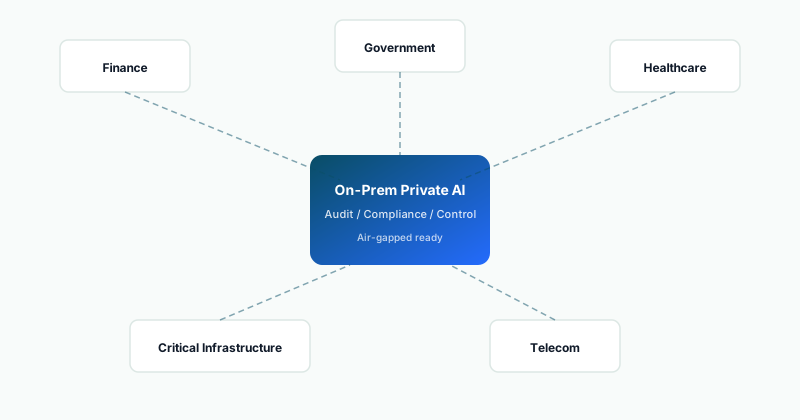
Compare across industries
Same four-part frame, different compliance priorities and first workflows — so you can hand the right brief to the right stakeholder.
| Industry | Primary frameworks | First workflow | Deployment | Key differentiator | On-prem priority |
|---|---|---|---|---|---|
| Financial Services | DORA, EU AI Act, GDPR | KYC / AML investigation support | On-prem & sovereign cloud | DORA third-party risk removal | Critical |
| Government & Public Sector | Data sovereignty, NIS2, EU AI Act | Casework and correspondence drafting | Air-gapped & classified networks | Zero egress sovereignty | Critical |
| Healthcare & Life Sciences | HIPAA, GDPR, EU AI Act | Clinical documentation support | On-prem in covered entity | PHI never leaves perimeter | Critical |
| Critical Infrastructure & Energy | NIS2, Data sovereignty, EU AI Act | Engineering knowledge assistant | OT-segmented & air-gapped | OT/IT segmentation safe | Critical |
| Telecommunications | NIS2, GDPR, EU AI Act | Network operations assistant | In-network on-prem | Flat-cost carrier scale | High |
Mapped to your obligations
| Industry | DORA | GDPR | HIPAA | NIS2 | EU AI Act | Data sovereignty |
|---|---|---|---|---|---|---|
| Financial Services | — | — | — | |||
| Government & Public Sector | — | — | — | |||
| Healthcare & Life Sciences | — | — | — | |||
| Critical Infrastructure & Energy | — | — | — | |||
| Telecommunications | — | — | — |
Why private AI now
Use this decision framework to assess whether your organization should prioritize on-premises or air-gapped AI over hosted alternatives.
Questions
Each executive brief is a short, decision-grade overview written for CIOs, CISOs, and risk and compliance leaders in a specific regulated industry. It lays out the pressures forcing an AI decision, why on-premises deployment is the right answer, how it maps to the compliance frameworks you answer to, the cost model, a 90-day adoption path, and the first workflows that deliver measurable payback.
We publish briefs for financial services, government and public sector, healthcare and life sciences, critical infrastructure and energy, and telecommunications. Each is tailored to the data-sensitivity, regulatory, and operational constraints of that vertical.
On-premises and air-gapped deployment keeps regulated data, models, and audit trails inside your perimeter. That removes external inference as a third-party dependency, satisfies data-residency and sovereignty requirements, and gives risk and audit teams a complete, inspectable trail for every AI action — the most direct path to compliant AI in regulated industries.
They are decision-grade briefs written for leadership. Each is concise enough to read before a meeting yet specific enough to bring to your security and compliance teams — including the objections your buying committee will raise and the questions to put to any vendor. When you want to go deeper, every brief links to the matching solution page, industry use cases, and deployment playbooks.
Financial services, government and defense, healthcare, critical infrastructure and energy, and telecommunications typically have the highest on-prem priority — driven by data sensitivity, regulatory frameworks like DORA and HIPAA, OT segmentation, or carrier-scale economics. Each brief includes a decision framework tailored to that vertical.
Each brief shows how on-premises deployment addresses the specific obligations of your industry: DORA third-party risk for banking, HIPAA PHI containment for healthcare, NIS2 resilience for essential entities in energy and telecom, and data sovereignty for government. The hub compliance matrix summarizes which frameworks each vertical brief covers.
Yes. Every brief has a print-ready PDF edition — open the brief and choose "Email me the PDF". We send a download link to your work email so you can forward the document to security, risk, and procurement stakeholders who were not in the room.
Next step
We will walk your security and compliance leads through the deployment model, compliance mapping, cost model, and first workflows for your industry — grounded in your constraints, not a generic pitch.