Enterprise AI Intelligence Report

2026 On-Premises Enterprise AI Agent Market Report

Sovereign infrastructure, model routing, and governed agents for the next phase of enterprise AI.

The 2026 enterprise AI agent market is defined by a major transition. AI is moving from assistants to operators, from pilots to infrastructure, and from cloud-only experimentation to governed on-premises, private-cloud, sovereign, and hybrid execution.

Read summary
Published
June 2026
Length
29 pages
Category
Enterprise AI
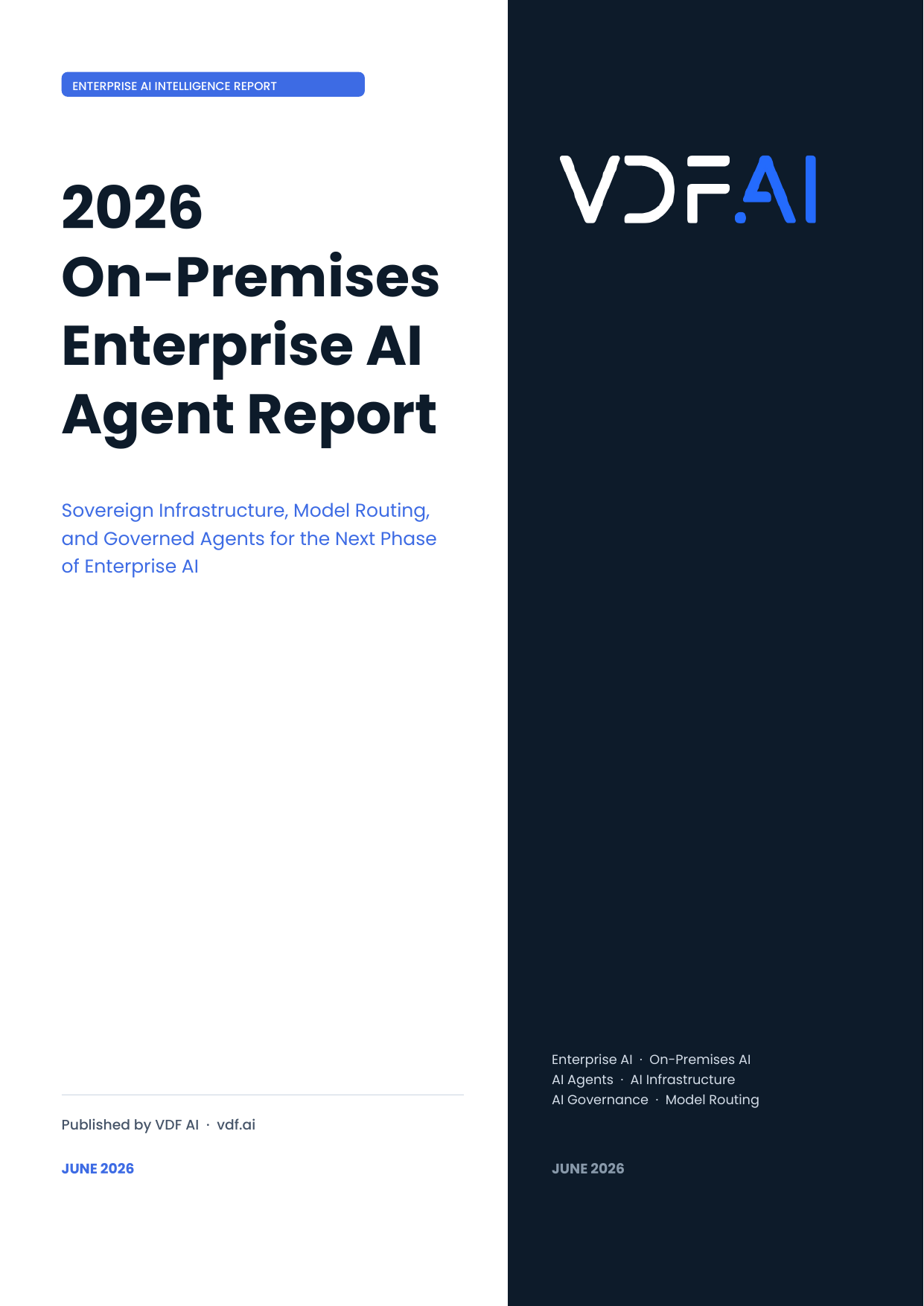
Cover of the 2026 On-Premises Enterprise AI Agent Market Report
Target audience CIOs, CTOs, CISOs, Chief Data Officers, AI transformation leaders, enterprise architects, compliance teams, infrastructure leaders, and digital transformation executives.
Executive summary

Enterprise AI is becoming operational infrastructure.

The first wave of generative AI adoption was dominated by copilots, chat interfaces, cloud APIs, and productivity experiments. The next wave is different. Enterprises are now moving toward AI agents: systems that can reason over business context, call tools, access internal data, execute workflows, coordinate with other agents, and influence real operational outcomes.

In the copilot era, the central question was: "Which model should we use?" In the agentic era, the central question becomes: "Where should autonomous AI execution live, how should it be governed, and who controls the data, models, workflows, audit trails, and operational boundaries?"

Market transition 2026

Enterprise AI moves from assistant experiments to governed agentic execution.

Agent adoption pressure 40%

Enterprise applications expected to integrate task-specific AI agents by the end of 2026.

Deployment gravity Hybrid

Sensitive workflows stay controlled while frontier models are used selectively.

What the report covers

The enterprise requirements behind governed AI agents.

The report explains why productive AI agents also need bounded autonomy, auditability, secure tool access, model control, and deployment flexibility.

Data sovereignty and private execution

Why AI agents change the sovereignty question from where data is stored to where reasoning, retrieval, tool use, and derived outputs are executed.

Governed agent orchestration

How enterprises can coordinate agents, workflows, approvals, permissions, and audit trails without creating uncontrolled agent sprawl.

Model routing economics

When smaller local models, private infrastructure, and selective frontier access combine to improve cost, latency, quality, and risk posture.

Infrastructure and TCO

Where on-premises, private-cloud, sovereign-cloud, and hybrid deployments fit as AI workloads become persistent operational infrastructure.

Compliance and operational boundaries

How regulated enterprises can connect policy enforcement, human oversight, identity-aware tool access, and evidence capture.

Private AI factories

Why enterprises are moving from isolated pilots to repeatable platforms for governed AI agents, internal knowledge, and secure workflows.

Governed agentic control plane

The new architectural layer for enterprise AI agents.

This report argues that the enterprise AI agent market is moving toward a governed agentic control plane: a layer that lets organizations deploy agents where they can be trusted, audited, economically controlled, and connected to internal systems without losing operational boundaries.

Local and private model execution

Model routing between small local models and larger frontier models

Multi-agent orchestration

Retrieval-augmented generation over internal data

Policy enforcement and audit logging

Human approval workflows

Identity-aware tool access

Compliance evidence capture

Secure on-premises, private-cloud, sovereign-cloud, and hybrid deployment

Section 3

What is pushing enterprises on-premises.

Six structural forces, not one. Any single driver can be argued away; together they are why 44.6% of global agentic AI deployment is expected to run on-premises in 2026.

Data sovereignty

Agents touching regulated records, contracts, clinical data, or classified information cannot operate through public cloud APIs. Sensitive data has to stay inside a controlled environment.

Regulatory compliance

AI regulations across the EU, US, and Asia-Pacific require documented controls, audit trails, and human oversight. On-premises platforms can produce stronger evidence.

Cost at scale

Above roughly 70–80% sustained utilization, dedicated infrastructure becomes more cost-effective than token-based cloud pricing — especially for high-volume recurring workflows.

Latency requirements

Real-time customer service, manufacturing operations, and cybersecurity workflows need inference latency that on-premises deployment can guarantee reliably.

Model sovereignty

Enterprises want to change models, use open-weight alternatives, and avoid lock-in to one cloud provider’s model roadmap.

Security controls

Air-gapped deployment, network isolation, and private inference prevent data exposure during agentic workflows that touch regulated systems.

Section 5

The utilization crossover, and what routing does to it.

Cloud APIs stay attractive for experimentation and elastic workloads. The cost profile changes once AI usage becomes high-volume recurring work. The crossover — typically 70–80% sustained utilization — is the point at which dedicated infrastructure becomes more economically compelling than token-based pricing.

The conclusion is not that on-premises is always cheaper. It is that on-premises becomes strategically valuable when control, sovereignty, and scale align.

Model routing changes the arithmetic. Instead of sending every request to the most expensive frontier model, route by complexity, sensitivity, latency, cost, and compliance requirement. Routing routine Q&A to a small local model (7B–13B) while reserving frontier models for complex non-sensitive reasoning reduces AI cost by 40–70% at scale.

Utilization crossover 70–80%

Sustained utilization at which on-premises TCO breaks even against cloud APIs.

Routing saving 40–70%

Cost reduction from routing by task complexity and sensitivity rather than to one model.

Small model range 7B–13B

Sufficient for internal Q&A, classification, summarisation, extraction, and ticket routing.

Section 8

Deployment models compared.

Five options, each with a real limitation. The report recommends hybrid — not as a compromise, but because model routing makes the choice per workload rather than per organisation.

Public cloud AI

Strengths. Fast start, frontier model access, elastic scaling, managed services, lower initial burden.

Limitations. Data sovereignty concerns, token cost variability, vendor dependency, limited air-gapped options.

On-premises AI

Strengths. Strong data control, local latency, model sovereignty, custom security, long-term cost control.

Limitations. Higher initial cost, capacity planning burden, specialised staff, energy requirements.

Private cloud AI

Strengths. Better control than SaaS, more flexible than on-premises, supports enterprise governance.

Limitations. May depend on external providers; sovereignty depends on contracts; significant cost.

Sovereign cloud AI

Strengths. Jurisdiction-specific controls, local compliance, suitable for the public sector.

Limitations. Fewer services than global cloud; higher cost; may still involve foreign technology providers.

Hybrid AI — the report’s recommendation

Strengths. Local for sensitive work, frontier for complex non-sensitive tasks, with model routing optimising cost, risk, and control.

Limitations. Requires sophisticated orchestration, policy governance, and integration effort.

Section 12

The seven-layer governed on-premises agent platform.

The reference architecture the report proposes. Governance is layer 6 of 7 rather than a wrapper, because controls added after agents are deployed mean expensive rework.

  1. Layer 1

    Enterprise data sources

    Databases, file systems, document repositories, CRM, ERP, HR systems, knowledge bases, APIs, legacy systems.

  2. Layer 2

    Secure data access

    Connectors, permission-aware retrieval, data classification, redaction, access policies, query logging.

  3. Layer 3

    Model layer

    Local LLMs, small language models, embedding models, rerankers, domain models, frontier model gateways, model registry.

  4. Layer 4

    Model router

    Cost-aware, latency-aware, risk-aware, data-classification-aware routing. Local-first, with policy-based cloud escalation.

  5. Layer 5

    Agent orchestration

    Task agents, supervisor agents, guardian agents, tool calling, workflow state, memory controls, human approval checkpoints.

  6. Layer 6

    Governance and compliance

    Policy engine, audit logging, evidence generation, approval workflows, risk scoring, compliance dashboards.

  7. Layer 7

    Operations

    Observability, cost monitoring, energy monitoring, performance monitoring, deployment management, security monitoring.

Section 15

Eight recommendations for 2026–2028 architectures.

1. Classify AI workloads by risk

Build a data sensitivity × regulatory exposure × business criticality matrix, and use it to decide whether each workload runs in public cloud, private cloud, sovereign cloud, on-premises, or hybrid.

2. Build an agentic control plane

One central plane managing agent identity, tool permissions, model routing, workflow approvals, audit logging, policy enforcement, and compliance evidence.

3. Adopt model routing early

Treat routing as a core platform capability: simpler tasks to local small models, sensitive tasks to on-premises models, complex non-sensitive tasks to frontier cloud.

4. Design for auditability first

Every production agent logs user, agent, model, prompt, retrieved data, tool calls, policy checks, output, human approvals, workflow actions, errors, escalations, and final result.

5. Treat small models as strategic assets

Evaluate 7B–13B models for internal Q&A, classification, summarisation, extraction, compliance checks, ticket routing, and document comparison. These workflows do not need frontier models.

6. Measure cost per business outcome

Cost per resolved ticket, per processed document, per compliance check, per human hour saved — not token cost. This is how AI earns its budget.

7. Plan for hybrid AI

Design for selective hybrid use even when committed to on-premises. The goal is controlled choice over what stays local and what may safely use frontier models.

8. Separate experiment from production

Formal review gates — security, governance, evaluation, access control, observability, cost monitoring, incident response, documentation — before any agent reaches production.

Sections 14 and 16

Conclusion: the next phase is won by architecture, not model size.

The 2026 market is defined by a transition: AI moving from assistants to operators, from pilots to infrastructure, from isolated experiments to governed execution, and from cloud-only enthusiasm to hybrid and sovereign architectures.

That creates a requirement rather than a preference. Agents must be deployed where they can be trusted, governed, audited, and economically controlled — which for regulated industries means on-premises, private-cloud, sovereign, or hybrid infrastructure.

Gartner expects 40% of enterprise applications to include task-specific AI agents by the end of 2026, up from under 5%. Regulation will move to evidence: AI inventories, model registries, agent registries, data lineage, audit logs, evaluation records, compliance dashboards. And infrastructure will increasingly be judged on energy per inference, which favours smaller models, local routing, and quantization.

The winning architecture combines local and private model execution, intelligent model routing, multi-agent orchestration across task, supervisor, and guardian agents, policy enforcement, identity-aware tool access, human oversight at critical decision points, comprehensive auditability, and hybrid deployment flexibility.

Gartner, by end 2026 40%

Of enterprise applications will include task-specific AI agents, up from under 5%.

Common agent risks 12

From prompt injection and tool misuse to shadow AI, workflow drift, and excessive autonomy.

FAQ

Questions covered in the report.

What are on-premises enterprise AI agents?

On-premises enterprise AI agents are AI systems deployed within an organization's own infrastructure that can reason, retrieve data, call tools, execute workflows, and support business processes while keeping sensitive data and operational control inside the enterprise environment.

Why are enterprises adopting on-premises AI agents?

Enterprises are adopting on-premises AI agents because they need stronger control over data, models, workflows, audit logs, compliance evidence, latency, cost, and security. This is especially important for regulated industries such as banking, healthcare, government, defense, insurance, and critical infrastructure.

Are on-premises AI agents cheaper than cloud AI?

On-premises AI agents are not always cheaper. Cloud AI is often more economical for low-volume or unpredictable workloads. On-premises AI becomes more attractive when usage is high, predictable, sensitive, latency-critical, or compliance-driven. Model routing can further improve economics by sending routine tasks to smaller local models and reserving larger models for complex tasks.

What is model routing in enterprise AI?

Model routing is the process of selecting the right AI model for each task based on cost, latency, quality, data sensitivity, compliance requirements, and workflow risk. A model router may send simple tasks to small local models and complex non-sensitive tasks to larger frontier models.

What is AI agent governance?

AI agent governance is the set of controls used to manage how AI agents access data, call tools, make decisions, generate outputs, escalate to humans, and produce audit evidence. It includes policies, permissions, logging, evaluation, approval workflows, monitoring, and compliance documentation.

What is the difference between on-premises AI and private cloud AI?

On-premises AI runs within an organization's own controlled infrastructure. Private cloud AI provides cloud-like capabilities in a dedicated or controlled environment. Both models can support stronger security and governance than public SaaS AI, but they differ in ownership, operations, scalability, and provider dependency.

Why is data sovereignty important for AI agents?

Data sovereignty is important because AI agents process data dynamically. They may retrieve documents, use customer records, call tools, generate summaries, and create new derived outputs. This means enterprises must control not only where data is stored, but also where and how AI execution happens.

What industries benefit most from on-premises AI agents?

The industries that benefit most include banking, insurance, healthcare, pharmaceuticals, defense, government, telecommunications, energy, manufacturing, legal services, engineering, public safety, and other regulated or data-sensitive sectors.

What is the future of enterprise AI agents?

The future of enterprise AI agents is likely to be hybrid, governed, and model-flexible. Enterprises will use local models for sensitive workflows, private infrastructure for regulated workloads, and frontier cloud models selectively. Agent governance, model routing, auditability, and compliance evidence will become core platform requirements.
Build Enterprise AI Agents Under Your Control

Move from AI experimentation to governed agentic execution.

AI agents are becoming part of enterprise infrastructure. Production AI requires more than automation: it requires data control, model control, auditability, compliance, and secure deployment.

Talk to VDF AI