Understand the request
The platform first identifies the user goal, the active product mode, the likely business domain, and the evidence needed before any answer is drafted.
Large language models are strong synthesizers, but they can answer confidently without enough evidence. VDF AI Networks improves quality by structuring every request around a simple discipline: gather evidence first, reason second, and verify before delivery.
Documents, internal knowledge, tool results, and missing information are carried into synthesis instead of being left implicit.
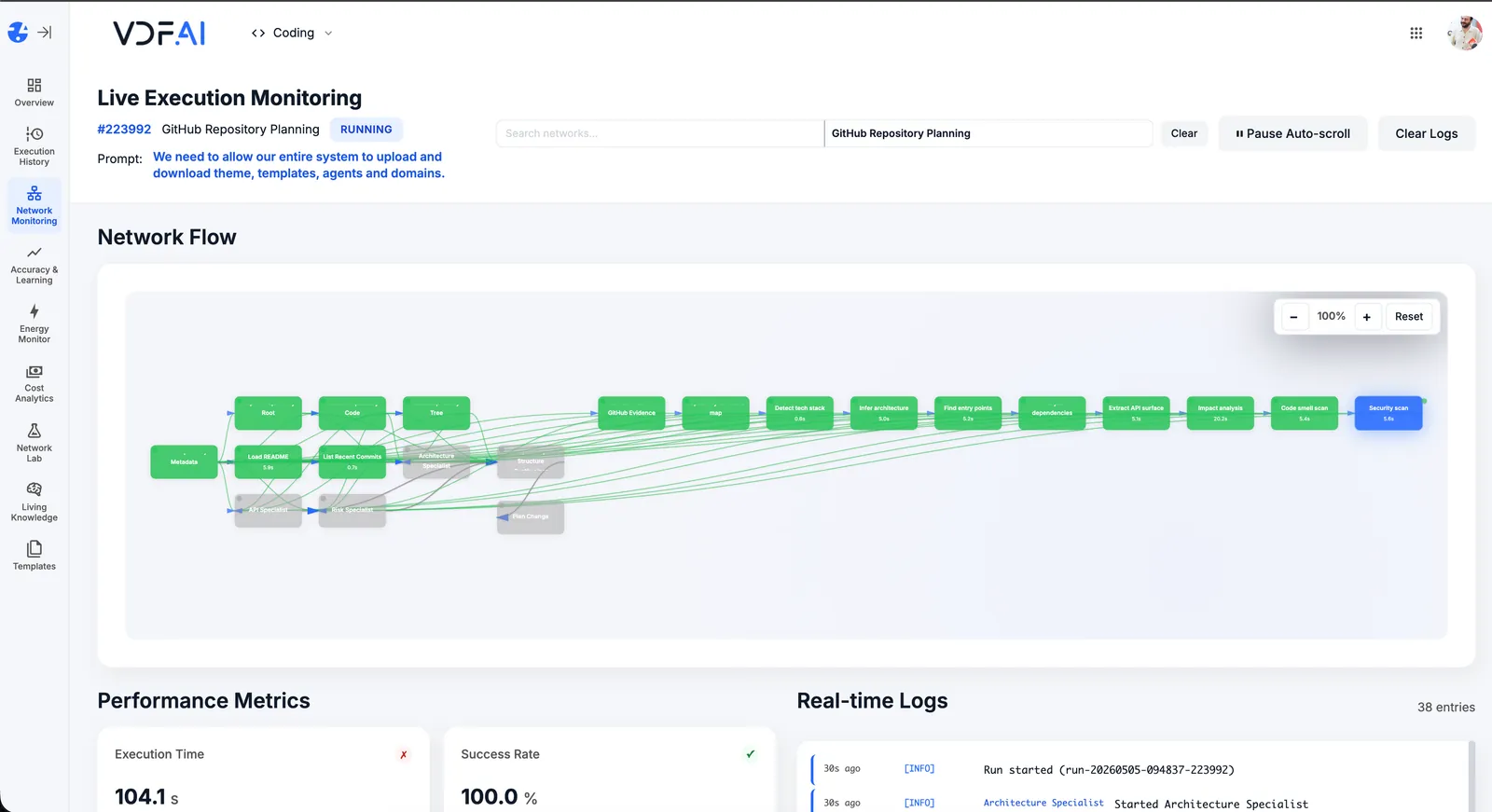
Each request moves through the same high-level spine so the model is working from available context, not from unsupported pattern completion.
The platform first identifies the user goal, the active product mode, the likely business domain, and the evidence needed before any answer is drafted.
A repeatable workflow is selected or assembled so the task follows a clear path: gather context, use the right tools, synthesize, and verify.
Search results, documents, repository context, internal knowledge, or structured business data are collected before the model is asked to reason.
Each reasoning step receives the relevant evidence, the user goal, known constraints, and clear instructions to state gaps instead of filling them with assumptions.
The final response is checked for structure, completeness, grounding, and usefulness before it reaches the user.
No single layer prevents hallucination on its own. Together, these layers make it easier for the platform to cite what is known and expose what is missing.
A coding task, document review, startup analysis, or general chat should not expose the same tools or behavior. Themes keep the experience focused from the start.
The platform aligns the task with the right operating context, model policy, and response style so regulated, technical, and general work do not blur together.
The system turns a natural language request into a practical brief: what the user wants, what evidence is available, what is missing, and what must not be invented.
Reusable workflow shapes make common tasks predictable. They help the platform collect source material before asking an AI agent to interpret it.
Instructions are assembled around the task, context, evidence, and expected output. The model is told to use what is present and call out what is not.
Deterministic checks and AI review work together to catch weak, malformed, unsupported, or incomplete responses before they become final answers.
The goal is not to make the model sound more confident. The goal is to make the system more selective about what the model sees, what it can use, and what must be checked before the answer is accepted.
The system first decides what kind of task it is handling, then chooses how to execute it, and only then asks a model to reason over the gathered context.
A trustworthy workflow does not hide missing information. It carries those gaps into the prompt and response so the model is less tempted to invent.
Simple checks catch many quality problems early. More expensive review is reserved for outputs where judgment and grounding matter most.
Hallucination is not solved by asking the model to “be accurate.” VDF AI Networks improves reliability by surrounding the model with context resolution, evidence collection, disciplined synthesis, and evaluation. The result is an AI workflow that can explain what the evidence supports, and when the evidence is not enough.