PLAYBOOK · GOVERNMENT & MARITIME
Run a national maritime administration on AI agents — inside your own borders.
Vessel registration, seafarer certification, port compliance, inspections, regulatory publishing — a flag state administration is dozens of specialist processes that all evidence against the same master records. VDF AI turns each process into a governed agent workflow: documents validated by AI, routine renewals processed zero-touch, inspections briefed before the inspector boards, and every single AI decision sealed in a SHA-256-verified audit ledger.
Governments across the world are mandating that a large share of public services run on AI agents within years, not decades. This playbook shows how a maritime administration — or any licensing-and-inspection regulator — gets there on VDF AI without sending a single record outside its jurisdiction.
The problem
80+ services, zero shared intelligence
A typical maritime administration runs its services on disconnected systems: one for vessel registration, another for seafarer certificates, spreadsheets for inspections, email for regulatory circulars. Applicants re-submit the same documents to every counter. Validations — insurance, classification, manning compliance, certificate authenticity — are manual. Inspectors board vessels with paper checklists and no risk intelligence. Leadership has no real-time picture of the fleet, and every new AI mandate lands on an architecture with no AI in it.
The VDF AI approach
One platform, specialist agents per service, one audit trail
Master records for vessels, seafarers, companies, and facilities live once in a unified data layer. Specialist agents — document intelligence, compliance monitoring, service processing, inspection support, regulatory intelligence, customer guidance — operate on those records through VDF AI Networks, each at its own configurable autonomy level. The Vault logs every decision with cryptographic proof, so the regulator can answer the question every auditor asks: show me exactly how this decision was made.
WHY THIS MATTERS NOW
Regulators are being told to automate — and to prove it
The pressure on public agencies is double-sided. National AI directives demand that services run on agents, with hard coverage targets and deadlines. At the same time, every automated decision a regulator makes — a license issued, a vessel detained, a certificate revoked — must be explainable, overridable, and defensible in court. Most platforms optimize for one side. VDF AI was built for both: agents that act, and a Vault that proves.
And because the entire stack — models included — runs on your infrastructure, data sovereignty is not a compliance checkbox negotiated with a cloud vendor. It is the deployment model.
WHAT YOU NEED TO START
Prerequisites for a pilot
Data & APIs
- Vessel / license registry extracts (even messy legacy exports)
- Certificate and document archive samples per service type
- National identity provider (OIDC/OAuth 2.0) sandbox
- Inspection history, if it exists in any structured form
Policy & controls
- Eligibility rules and fee logic for 2–3 pilot services
- Escalation matrix: which decisions require an officer's sign-off
- Autonomy policy: which case types may run unsupervised
- Bilingual requirements (e.g., Arabic/English with RTL)
People
- One domain SME per pilot service
- One authorizing officer for human-in-the-loop gates
- One data engineer for connectors and migration
- Optional: AI governance committee sponsor
REFERENCE ARCHITECTURE
One network per service, shared masters, one ledger
OIDC
vessels · seafarers · companies · facilities
regulations · conventions · circulars · prior cases (pgvector, on-prem)
classification societies · labor registry · payment · certificate PKI
intent templates · SEEMR routing · configurable autonomy · human approval gates
SHA-256 proof
PLAYBOOK · STEP BY STEP
From paper counters to governed agents
Register the ecosystem as typed tools
Classification society APIs, labor and company registries, payment gateways, and the national identity provider each become a Custom HTTP tool in AgentsHub — with secrets managed centrally and every call logged. Systems that only exist as legacy databases connect through VDF Data.
Vectorize the regulatory corpus
Maritime laws, international conventions, ministerial circulars, and resolved case files go into an on-prem pgvector index. This Private RAG layer powers three things at once: a natural-language regulatory Q&A assistant for staff and the public, cited compliance reasoning inside every agent, and impact analysis when new international instruments are published.
Author the specialist agents
Each agent is a declarative YAML definition — no glue code. The Document Intelligence Agent combines OCR with LLM understanding to validate certificates against expected schemas and issuing-authority data, flagging expired, inconsistent, or tampered documents. The Service Processing Agent executes eligibility checks, fee calculation, and issuance for a service. The Compliance Monitoring Agent runs nightly batch scoring across the whole fleet. New service, new agent — created through the same interface, often in a day.
Compose service networks with autonomy gates
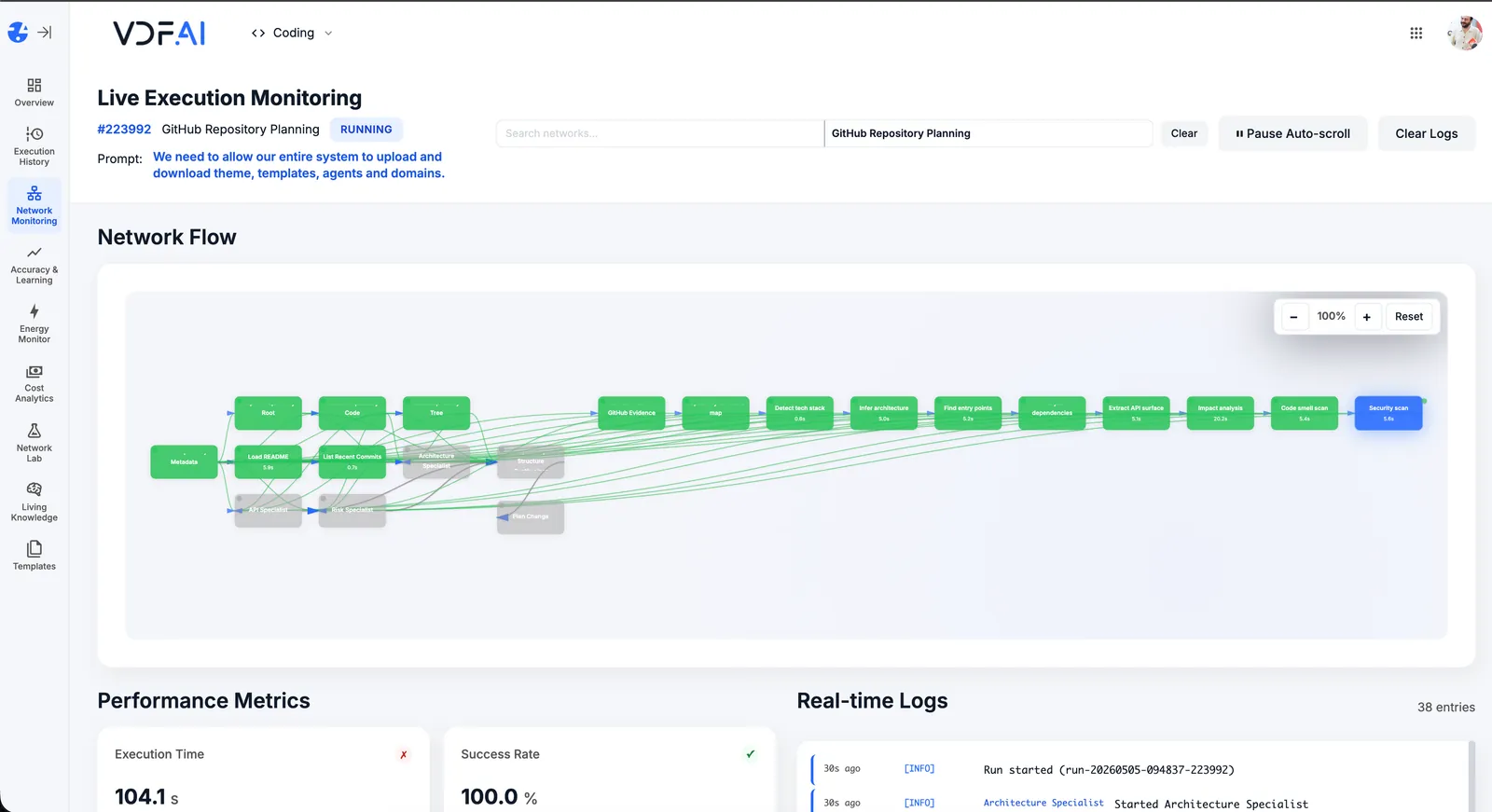
An intent template decomposes each service into sub-tasks and binds them to agents. Autonomy is a dial, not a rewrite: start every network fully supervised (officer approves each AI recommendation), then graduate case types to zero-touch as Vault evidence and accuracy testing justify it. Decisions with legal consequence — suspensions, detentions, revocations — keep a mandatory human gate permanently.
Put inspection intelligence in the field
Before a visit, an inspection network compiles a risk score and briefing dossier from history, certificate status, and prior deficiencies. During the visit, inspectors get instant, cited regulatory answers from the RAG layer and can dictate findings for automatic transcription and classification. Afterwards, the network drafts the report and corrective-action notices within minutes — routed to an officer for approval before anything is issued.
Let SEEMR and the Vault run governance
SEEMR routes each sub-intent to the right model — sovereign on-prem models for personal and regulatory data, efficient SLMs for routine classification — and learns from every reviewed decision. The Vault seals every run with a SHA-256 proof retrievable on demand, satisfying explainability SLAs measured in seconds, not meetings.
OUTCOMES
Officers decide; agents do the paperwork
compliant standard renewals processed without human intervention, with full evidence packs.
not weeks — document validation and inspection report drafting collapse from queue-time to run-time.
audit-ready by construction: every decision traceable to inputs, prompts, models, tool calls, and the human who approved it.
not vendor tickets — new services, rule changes, and autonomy adjustments are done by the authority's own staff.
SEEMR REFERENCE
Autonomy that earns its way up
SEEMR's learning modes are what make progressive autonomy safe in a regulatory setting. Reviewer decisions feed back into routing and thresholds: case types where agents consistently match officer judgment graduate toward autonomy; case types that generate overrides stay supervised. The authority controls the dial at all times — and can turn any agent down to fully supervised in real time, without a vendor ticket.
FREQUENTLY ASKED QUESTIONS
What teams ask before shipping this playbook
Can AI legally issue licenses and certificates?
The platform enforces whatever your legal framework requires. Typical pattern: agents fully process and prepare the decision; issuance is automatic only for case classes the authority has formally delegated, and every consequential action (suspension, detention, revocation) requires named-officer sign-off. The Vault records who — human or agent — did what, when, and why.
Our records are decades of paper and legacy databases. Is that a blocker?
It's the starting point, not a blocker. VDF Data handles source discovery, mapping, and cleansing pipelines; the Document Intelligence Agent accelerates digitization by extracting structured data from scanned archives. Pilots deliberately start on services whose data is in the best shape.
Does this work in Arabic (or any RTL language)?
Yes. The data layer stores full Unicode; conversational and document agents are benchmarked per language with separate human-review thresholds, and sovereign Arabic-capable models can be served through local inference so language processing never leaves jurisdiction.
What about offline use — inspectors on ships without connectivity?
Inspection workflows support offline operation with on-device assistance and synchronization on reconnect. The Vault entry is sealed at sync time with the full offline activity record.
How do we hit national AI-coverage targets without betting the administration on day one?
Progressive autonomy is the mechanism: every service launches supervised, accumulates evaluation evidence, and graduates case types to automation on data rather than optimism. Coverage grows service by service, and the same evaluation harness produces the quarterly adoption reporting oversight bodies ask for.
How fast can a pilot run?
A two-to-three-service pilot — typically document validation plus one renewal workflow — reaches supervised production in eight to twelve weeks on your infrastructure. The platform layer (orchestration, audit, RAG, governance) deploys in days; the time goes into your rules and your data.
RELATED PLAYBOOKS
Continue with related VDF AI patterns



GET IN TOUCH
You Have Questions
Tell us what you’re trying to achieve—governed AI Networks, enterprise RAG, deep integrations, or on‑premise deployment. We’ll help you map the right architecture, security posture, and rollout path. If you’re moving beyond AI pilots and need scalable, auditable execution, reach out—our team is ready to help.