On June 12, 2026, Anthropic published a short, striking statement: a US government directive required it to suspend access to two of its models — Fable 5 and Mythos 5 — for any foreign national, inside or outside the United States. The company disputed the decision, argued that applying the same standard across the industry would, in its words, “essentially halt all new model deployments,” and said it was working to restore access.
Set aside the merits of the dispute for a moment. The detail that should stop every CIO, CISO, and Head of AI cold is simpler than the policy argument: a model that thousands of organizations had built on was switched off by a decision made entirely outside those organizations. The models did not get worse. They did not hallucinate their way into an incident. Access to them simply disappeared, overnight, by directive.
That is not a security story. It is a sovereignty story. And it is the clearest real-world illustration yet of a risk that on-premises and sovereign AI vendors have been describing for two years: when your AI lives behind someone else’s API, you do not control the kill switch. Our self-hosted Claude alternative sets out what can replace that dependency inside your own network.
What actually happened
The facts, as stated in Anthropic’s own announcement, are narrow but consequential:
- A US government directive instructed Anthropic to suspend access to Fable 5 and Mythos 5 for any foreign national, whether inside or outside the United States. Other models were unaffected.
- The stated reason was national security. The government said it had become aware of a method of “bypassing, or ‘jailbreaking’” Fable 5 — reportedly by asking the model to read a specific codebase and fix software flaws.
- Anthropic disagreed that a narrow potential jailbreak should be cause for recalling a commercial model, noting that comparable capabilities are available from other frontier models, and said it would share more details and work to restore access.
Whether the directive was proportionate is a debate for policymakers. What matters for your architecture is the mechanism, not the merits. A capability you depend on can be removed by an actor you don’t control — a government, a regulator, a court, or the vendor itself — and there is nothing in a standard cloud-API contract that prevents it.
This isn’t a security story. It’s a control story.
Most enterprise AI risk conversations still center on the wrong question: Is the model safe? Is the provider compliant? Is the data encrypted in transit? Those questions matter, but they assume the service keeps running. The Fable 5 and Mythos 5 suspension breaks that assumption.
The real question that this event surfaces is about control of the kill switch:
- Who can revoke your access to the model — and on what notice?
- In which jurisdiction does inference physically happen?
- If the vendor changes terms, prices, or availability, do your operations survive?
- Can you prove, to a regulator or a board, where your data went and who could touch it?
These are data sovereignty questions, and they don’t have contractual answers. They have architectural answers. You either designed your AI so that a third party can turn it off, or you didn’t.
The data sovereignty spectrum
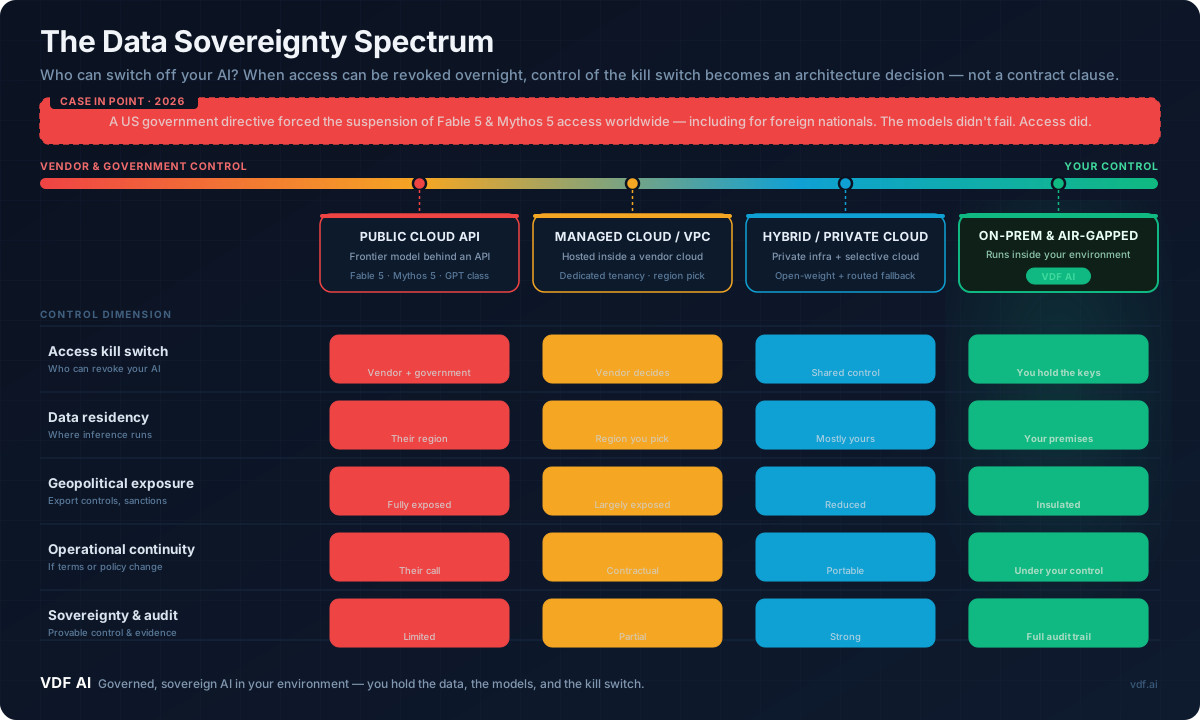
The featured image above maps this out as a spectrum. On the left, you have the public cloud API — a frontier model like Fable 5, Mythos 5, or a GPT-class system, reached over the internet. It is the most capable and the easiest to adopt, and it is also where the vendor and, as we just saw, a government hold the kill switch. On the right, you have on-premises and air-gapped AI: models that run inside infrastructure you own, where no external party can revoke access, no foreign jurisdiction sits in the inference path, and every request is auditable.
Read across the five control dimensions and the pattern is unambiguous:
| Control dimension | Public cloud API | Managed cloud / VPC | Hybrid / private | On-prem & air-gapped |
|---|---|---|---|---|
| Access kill switch | Vendor + government | Vendor decides | Shared | You hold the keys |
| Data residency | Their region | Region you pick | Mostly yours | Your premises |
| Geopolitical exposure | Fully exposed | Largely exposed | Reduced | Insulated |
| Operational continuity | Their call | Contractual | Portable | Under your control |
| Sovereignty & audit | Limited | Partial | Strong | Full audit trail |
There is no “right” point on the spectrum for every workload — and that is the important nuance. The goal is not to abandon frontier models. It is to stop accidentally placing business-critical and regulated workloads at the far-left, lowest-control end of the spectrum simply because the API was the path of least resistance.
The future risks every AI leader should now price in
The Fable 5 and Mythos 5 suspension is a specific event, but it is a preview of a class of risks that will only grow as AI becomes load-bearing infrastructure. Boards should now explicitly price in:
- Geopolitical and export-control risk. AI models are increasingly treated as strategic technology. Export controls, sanctions, and national-security directives can sever access by nationality or geography — exactly what happened here — with little warning. Organizations that operate across borders are the most exposed.
- Vendor-policy risk. A provider can deprecate a model, change acceptable-use terms, raise prices, or restrict a use case for its own commercial or safety reasons. Your roadmap is hostage to theirs.
- Concentration risk. When most of an industry runs on the same handful of model APIs, a single disruption becomes a systemic event. Financial regulators already treat this as third-party concentration risk under frameworks like DORA — and AI deepens it.
- Continuity and resilience risk. If a model your customer-facing workflow depends on goes dark, what is the fallback? For most cloud-only deployments today, the honest answer is “there isn’t one.”
- Audit and evidence risk. When a regulator asks where your data was processed, who could access it, and whether you could have prevented an exposure, “we trusted the vendor” is not an answer that survives scrutiny under the EU AI Act, GDPR, or sector rules.
None of these are hypothetical anymore. June 12 made the first one concrete.
How on-premises and sovereign AI minimizes the kill-switch risk
The mitigation is not “never use the cloud.” It is to own the parts of your AI stack that you cannot afford to have switched off, and to make external dependencies optional rather than load-bearing. That is precisely what VDF AI is built to do.
VDF AI is a governed orchestration layer that runs inside your environment — on-premises, in your private cloud, or fully air-gapped. It changes the sovereignty equation in a few concrete ways:
- Models you hold, not models you rent. With on-premises deployment, your core models are open-weight systems running on your hardware. There is no external API in the critical path that a directive or a vendor can disable.
- Policy-governed routing across models. The VDF AI Router lets you define hard policy gates: which workloads must stay on local models, which may use an external frontier API, and what happens automatically if a provider becomes unavailable. A suspension upstream becomes a routing fallback, not an outage.
- Private retrieval and agents inside the boundary. VDF AI Networks keeps documents, embeddings, vector indexes, and agent tool calls inside your controlled environment — addressing the broader data sovereignty risks that extend well beyond the model itself.
- Provable control. Every routing decision, retrieval, and tool call is logged and reproducible, giving you the audit evidence that regulated industries need and that a cloud-only architecture struggles to produce.
- No lock-in. Because orchestration and governance live in your layer — not the vendor’s — you can swap models without re-architecting. That is the difference between a platform you control and one that controls you.
The result is a stack where the latest frontier model is a capability you can reach for when policy allows — not a single point of failure your whole business depends on.
Why small language models (SLMs) are the value play
The instinct after an event like this is to think “we need our own frontier model on-prem.” For a handful of organizations, that is realistic. For everyone else, it misreads where the value actually is.
The quieter, more important truth is that most enterprise AI work does not need a frontier model at all. Classification, entity extraction, document triage, routing, summarization, retrieval-augmented answers over your own knowledge, structured drafting — these are the high-volume, high-ROI tasks that fill an enterprise AI backlog, and they are squarely within the reach of small language models (SLMs).
SLMs are compact, open-weight models that run on modest, ownable hardware. Their advantages map almost perfectly onto the risks the Fable 5 and Mythos 5 suspension exposed:
- Sovereign by construction. An SLM you host cannot be switched off by a directive or a vendor. The kill switch is yours.
- Value-oriented economics. A fine-tuned SLM specialized to your domain often outperforms a general frontier model on your specific task — at a fraction of the cost, latency, and energy. Routing high-volume work to smaller models is one of the most reliable ways to cut AI spend.
- Predictable and auditable. Smaller, pinned models behave consistently, which matters more for a regulated workflow than raw capability. You can version, evaluate, and freeze them.
- Composable. With governed orchestration, a fleet of specialized SLMs handles the bulk of the work, and an external frontier model is reserved — under policy — for the genuinely hard, non-sensitive cases.
This is the core of a value-oriented sovereign AI strategy: put the workhorse SLMs where you control them, keep the data inside the boundary, and treat frontier-model access as an enhancement, not a dependency. You get most of the value, most of the time, with none of the kill-switch exposure.
A practical sovereignty checklist
For teams reassessing their AI architecture this week, start here:
- Inventory your dependencies. Which production workflows would stop if a single model API were suspended tomorrow?
- Classify by sensitivity and criticality. Identify the workloads that must never leave your boundary, and the ones that can tolerate an external API.
- Move the load-bearing work in-house. Stand up on-premises SLMs for high-volume and regulated tasks.
- Make external models optional. Use policy-governed routing so an upstream disruption triggers a fallback, not an outage.
- Prove it. Ensure every model call, retrieval, and tool use is logged and reproducible for audit.
- Plan your exit. For every external provider, know exactly how you would replace it — before you need to.
The takeaway
Fable 5 and Mythos 5 will, in all likelihood, come back. Anthropic said as much. But the lesson outlives the incident: in 2026, control of the kill switch is an architecture decision, not a contract clause. The organizations that came through June 12 unbothered were not the ones with the best vendor relationship. They were the ones whose critical AI ran on models they controlled.
Data sovereignty is no longer a compliance checkbox or a hosting-region dropdown. It is the difference between an AI strategy that survives a directive and one that doesn’t. On-premises deployment, governed orchestration, and a value-oriented fleet of small language models are how you put yourself at the right end of the spectrum — and keep your hand on your own switch.
Want to see where your AI sits on the sovereignty spectrum? Talk to the VDF AI team about moving your critical workloads on-premises, or explore how VDF AI runs in your environment.
Sources and further reading
- Anthropic: Statement on the US government directive to suspend access to Fable 5 and Mythos 5
- Data Sovereignty Risks — Regulated Industries
- Data Sovereignty vs. Data Residency in AI Procurement
- The Hidden Risks of Cloud-Only AI
- Build an Enterprise AI Agent Platform Without Vendor Lock-In
- VDF AI Router · VDF AI Networks · On-Premises AI