Most AI platform teams start routing with a rule table. It is the obvious first implementation: if the task is summarization, use model A; if the task is code, use model B; if the workflow is regulated, force model C; if latency crosses a threshold, try model D. The table is easy to explain, easy to review, and easy to ship.
It is also the wrong long-term abstraction for a serious AI platform.
We built SEEMR, the Self-Evolving Model Router inside VDF AI Networks, because enterprise AI routing is not a static configuration problem. It is a continuously changing dispatch problem under policy, quality, latency, cost, energy, data residency, and availability constraints. A static table can encode the policy. It cannot keep up with the fleet.
This article is the engineering story behind that decision. It is written for CTOs and platform engineers evaluating AI infrastructure: the people who need to decide whether a platform’s routing layer is a real operating system for AI workloads or a config file with a better UI.
For the full design account, read the Self-Evolving Model Router white paper and the SEEMR architecture overview. This post explains the architectural judgment behind the work.
Why Rule Tables Fail in Real AI Fleets
A rule table assumes the routing problem is mostly known in advance. That assumption breaks quickly.
The model catalog changes. New open-weight models arrive, provider models are updated, context windows expand, pricing moves, and models that were weak six months ago become good enough for specific workloads. A static rule table does not naturally absorb that change. Someone has to notice, test, update the rule, deploy it, and own the consequences.
The workload mix changes too. An internal assistant that started with policy Q&A may later handle contract extraction, support triage, engineering planning, and incident review. Each task has a different tolerance for latency, cost, hallucination risk, source attribution, and data movement. The table grows from ten rules to hundreds, and nobody can confidently explain which rule will fire in a composite agent workflow.
Runtime behavior is non-stationary. Provider quotas oscillate. Shared cloud endpoints drift. Local GPU availability changes by workload. A model that was fast during testing may be slow under production traffic. A model that is usually strong on synthesis may start failing a particular document type after a prompt-template change. A rule table sees none of that unless engineers keep adding special cases.
The expensive failure mode is not that a static router makes a bad decision once. The expensive failure mode is that it keeps making the same stale decision until a human notices. At enterprise scale, that means unnecessary spend, avoidable latency, inconsistent quality, and in regulated environments, routing decisions that become hard to defend after the fact.
The Constraint: Learn Inside Policy, Never Around It
The answer is not “let the router learn everything.” Unbounded learning is unacceptable in enterprise AI. A platform cannot learn its way around a compliance boundary, a data residency rule, a pinned model, or a tool restriction.
This was the core SEEMR design constraint: policy must be deterministic, but preference must be adaptive.
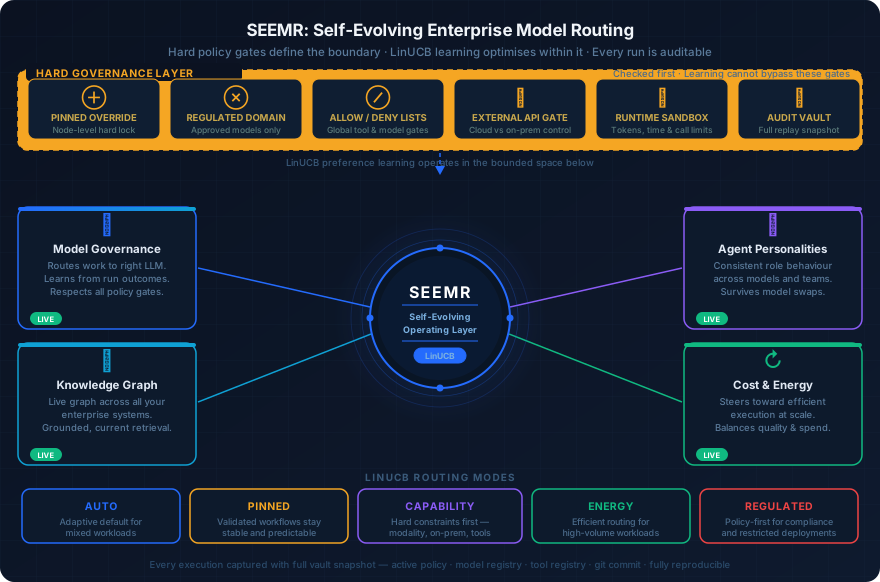
Policy runs first. Pinned models, allow-lists, deny-lists, regulated-domain rules, external API restrictions, required capabilities, context-window limits, and deployment-boundary constraints are evaluated before the learning layer gets to choose anything. If a regulated workflow has no approved candidate, the router should halt with a machine-readable reason code. It should not improvise.
Inside that policy envelope, however, a fixed table is too weak. If five approved models can all handle a task, the platform should learn which one is performing best for that context. If latency degrades, failures increase, or an alternative model begins producing better evaluated outputs, the router should adapt without waiting for a governance meeting.
That separation is what makes SEEMR useful to both engineering and compliance stakeholders. Engineers get a routing layer that improves with operational evidence. Governance teams get hard boundaries that remain hard. The system is adaptive where adaptation is safe and deterministic where determinism is required.
The Six-Tier Router as an Engineering System
SEEMR is not a single model that predicts the “best” LLM. It is a six-tier dispatcher. The composition matters more than any individual tier.
The first tier is policy enforcement. This is the inviolable layer. It decides what is allowed before the router considers what is optimal. It handles pinned models, regulated-domain allow-lists, explicit deny-lists, external API toggles, and hard capability constraints.
The second tier is prompt-aware retrieval shortlisting. SEEMR keeps a small index of historical prompt embeddings and model outcomes. When a new request arrives, the router can shortlist models that previously performed well on conceptually similar tasks. If the signal is missing or too sparse, it degrades to the full catalog instead of failing.
The third tier is rule-based filtering and multi-objective scoring. Deterministic predicates remove candidates that cannot satisfy the request: context length, required modality, deployment boundary, latency threshold, or tool compatibility. Survivors are scored across quality, cost, latency, and energy according to the operating preset, such as balanced, eco, or max-quality.
The fourth tier is predictive re-ranking. Before the bandit makes a choice, the router uses per-arm history such as mean reward, recent median latency, and failure rate. This reduces cold-start noise because the learner does not need to rediscover everything the registry already knows.
The fifth tier is contextual bandit selection. SEEMR uses a disjoint per-arm LinUCB learner. Each model is an arm with its own parameters, and each request is encoded as a sparse context vector containing metadata such as domain, node type, requested capability, regulation status, prompt-size bucket, upstream fan-in, tool usage, and local-runtime availability.
The sixth tier is challenger exploration. A small, bounded share of traffic can be dual-routed to a challenger model so the platform keeps collecting preference evidence. This prevents the policy from over-exploiting yesterday’s winner and gives new models a controlled path into the fleet.
Every tier is feature-gated. If a signal is unavailable, SEEMR degrades to the next simpler strategy. That graceful-degradation envelope is the difference between an intelligent router and a brittle one.
Why LinUCB and Disjoint Per-Arm Learning
We did not choose LinUCB because it is fashionable. We chose it because it fits the operational shape of model routing.
The router needs to balance exploitation and exploration. Exploitation means choosing the model that appears best for the current context. Exploration means occasionally trying an uncertain candidate so the system does not get stuck on an outdated preference. This is exactly the contextual bandit problem: choose an arm, observe a delayed and partial reward, update the policy, and make a better decision next time.
LinUCB has two practical advantages for an enterprise platform. First, its decisions are inspectable. The router can record the estimated reward, the uncertainty bonus, the selected arm, the candidate list, and the context features that shaped the decision. That matters when an engineer asks why a request routed to one model instead of another.
Second, SEEMR uses disjoint per-arm parameters. Each model has its own state. That is less sample-efficient than a single shared predictor, but it is more robust in a model catalog that changes constantly. Adding a new model does not require retraining a global function before the catalog can use it. Removing a model does not contaminate the remaining arms. A regression in one model’s behavior does not automatically bleed into the policy for another.
This is an engineering tradeoff. In a stable academic benchmark, a shared model may look attractive. In a production AI platform where providers, versions, deployment locations, and capabilities change every week, arm isolation is worth more than theoretical sample efficiency.
The other deliberate choice is that raw prompt embeddings are not the bandit context. Embeddings are useful for prompt-aware shortlisting, but the bandit needs deterministic, cheap, reproducible features. Hashed metadata is easier to replay during offline training, easier to inspect in telemetry, and less vulnerable to silent behavior changes when an embedding model is upgraded.
How the Router Evolves Without Becoming Opaque
“Self-evolving” should make a CTO cautious. Many systems use that language to hide an opaque feedback loop. SEEMR’s version is specific.
There are three feedback loops. The online loop updates the chosen arm when a request completes and an evaluation score is available. The failure loop treats timeouts and errors as bounded negative rewards instead of dropping them from training data. The offline loop batches the run vault, re-derives priors over a longer window, and hot-reloads fresh router state into the live engine.
The online loop adapts quickly. The offline loop stabilizes the policy against short-horizon noise. The failure loop ensures reliability problems become learning signals, not missing data. The combination is what makes the router self-correcting without relying on manual rebalancing.
Telemetry is not optional. Every routing decision should be reconstructable: active policy, candidate set, filtered candidates, scores, selected model, failover list, routing reason, model version, latency, reward, and update path. If a workflow is regulated, the evidence burden is even higher. The platform must show which models were approved, which constraints were active, and why the router selected a particular candidate.
This is where many routing systems fall short. A rule table is easy to inspect before execution but weak after the environment changes. A black-box learned router may adapt, but it is hard to defend. SEEMR is designed to sit between those extremes: deterministic policy, logged scoring, inspectable learning, bounded exploration, and replayable state.
What Engineers Should Evaluate Before Recommending a Platform
If you are evaluating an AI platform, do not stop at “does it support multiple models?” Multi-model support is table stakes. The real question is how the platform decides.
Ask whether routing is per application, per workflow, per agent step, or per request. Per-application routing is usually too coarse. In a multi-agent workflow, one step may need a small local model for classification, another may need a strong reasoning model, and another may need a model approved for regulated data.
Ask how policy interacts with optimization. If cost optimization can override data residency, the router is unsafe. If policy is so rigid that it prevents adaptation inside approved boundaries, the router is operationally expensive. The right architecture separates hard constraints from learned preferences.
Ask what happens when signals disappear. If the embedding index is unavailable, can routing continue? If bandit state fails to load, is there a deterministic fallback? If a provider times out, is the failover list already ordered, or does the system re-run the router under incident pressure? Graceful degradation should be designed in, not patched in after the first outage.
Ask how new models earn traffic. A static table tends to ignore new models until someone manually edits it. A naive learned router may over-explore and damage quality. A production router needs bounded challenger traffic, evaluation hooks, and promotion criteria.
Ask whether the router is an engineering primitive or a product afterthought. In a platform built for enterprise AI, routing should be part of the orchestration contract: visible in traces, configurable by policy, testable in staging, exported in audit logs, and understandable to the teams who own the workloads. If routing is hidden behind vendor defaults, engineers cannot reason about cost, failure modes, model drift, or compliance exposure. They can only trust the platform vendor, which is not the same thing as operating the platform.
Ask what evidence is available after the fact. Engineers need traces for debugging. Security teams need logs. Compliance teams need audit evidence. Executives need confidence that the AI platform can scale without becoming an ungoverned model zoo.
That is why we built SEEMR instead of a rule table. A rule table can launch an AI pilot. It cannot operate a changing AI fleet. A self-evolving router, bounded by policy and exposed through telemetry, gives the platform a way to improve while staying explainable.
For the deeper implementation detail, start with the SEEMR white paper. For the product architecture context, see VDF AI Networks and the SEEMR architecture page.