PLAYBOOK · TELECOMMUNICATIONS
A NOC copilot that already read every runbook.
Network Operations Centers handle alarm storms with runbooks that age out of memory. This playbook turns OSS/BSS endpoints into Custom HTTP tools, indexes runbooks into a vector store, and lets a triage network recommend the right remediation per alarm signature.
Network Operations Centers don't need another dashboard — they need the dashboards to mean something at three in the morning. VDF AI ingests OSS/BSS alarms as a stream, correlates them with vectorized runbooks and topology, and gives the engineer a single recommendation, with the runbook excerpt that justified it.
The problem
Alarms flood faster than humans triage
OSS/BSS alarms arrive at thousands per minute. Engineers context-switch between alarm consoles, ticketing tools, and wikis of runbooks. The remediation knowledge exists — it's the discovery that breaks under load.
The VDF AI approach
Correlate, retrieve, recommend
The triage network maps each alarm to the most relevant runbook, calls OSS APIs to gather context, and proposes a remediation playbook with a confidence score. Engineers approve or override.
WHY THIS MATTERS NOW
Alarms arrive faster than humans can correlate
Telecom NOCs run on tribal knowledge. The senior on-call knows that this alarm pattern, on this region, in this season, usually means a fiber cut on Route 7. New hires take years to learn that. Meanwhile the alarm storm continues every night.
VDF AI codifies that tribal knowledge as vectorized runbooks and specialist agents. The Correlator groups alarms by signature; the Runbook Retriever pulls matching procedures; the Remediation Planner emits a single recommendation with risk, ETA, and a roll-back path.
WHAT YOU NEED TO START
Prerequisites for a pilot
Data feeds
- Alarm feed (SNMP, Kafka, or webhook)
- Topology snapshot or CMDB read API
- Ticketing system endpoint
- Optional: weather and traffic feeds
Knowledge
- Runbooks (Markdown, Word, Confluence)
- Post-mortems and root-cause notes
- Service map per region
- Maintenance window calendar
People
- One NOC team lead
- One SRE for runbook curation
- One network architect
- Optional: vendor-support liaison
REFERENCE ARCHITECTURE
From alarm signature to remediation
SNMP · Kafka feed
topology · ticket · CMDB
pgvector
Intent: triage-alarm
PLAYBOOK · STEP BY STEP
From alarm to guided remediation
Wrap OSS/BSS APIs as Custom HTTP tools
Topology lookup, CMDB query, ticket create — each becomes a typed tool VDF agents can call.
Vectorize runbooks and post-mortems
Markdown, Confluence, Word — VDF Data ingests them all. Per-region indexes scope retrieval.
Build the triage agents
The correlator groups alarms by signature, the retriever finds matching runbooks, the planner emits a remediation with risk and ETA.
Compose the Network
Intent template triage-alarm binds correlator → retriever → planner. SEEMR routes by alarm severity.
Operate at NOC scale
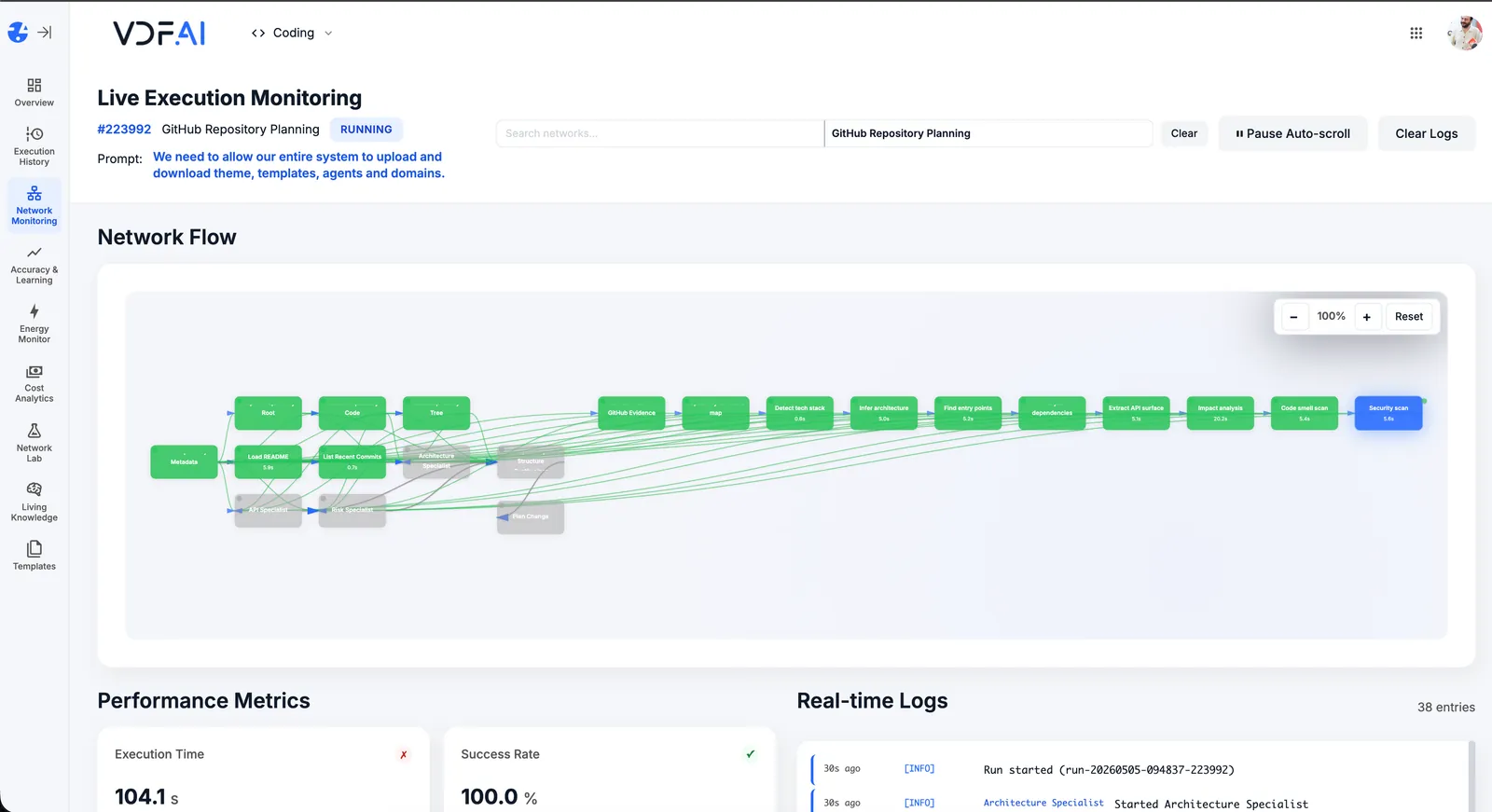
Live Execution Monitoring exposes per-alarm flows. Energy tracking shows the cost of each recommendation.
OUTCOMES
Fewer escalations, faster MTTR
MTTR on known alarm signatures.
engineer throughput during alarm storms.
recommendations carry runbook citations and topology evidence.
SEEMR REFERENCE
Routing for criticality
P1 alarms route to your most capable private model. P3 maintenance signals route to small models. SEEMR learns the boundary as your network evolves.
FREQUENTLY ASKED QUESTIONS
What teams ask before shipping this playbook
How does this fit with our existing OSS?
VDF AI sits beside it. The OSS continues to produce alarms; VDF AI subscribes to the stream and produces recommendations alongside.
Can we auto-remediate?
Yes, for vetted runbooks. Recommendations carry a confidence score; you decide above which threshold an action runs automatically.
How are seasonal patterns handled?
SEEMR's knowledge-graph mode incorporates temporal signals. Recurring patterns get cheaper, faster routing over time.
What if topology data is stale?
The Correlator surfaces conflicts when alarm patterns contradict the topology snapshot, prompting a refresh.
Does this work for multi-vendor environments?
Yes. Each vendor's alarm vocabulary becomes a structured input; the Correlator normalizes them.
How fast is a recommendation?
Sub-second on a single GPU node for routine alarms; SEEMR routes complex storms to your highest-capability model.
RELATED PLAYBOOKS
Continue with related VDF AI patterns



GET IN TOUCH
You Have Questions
Tell us what you’re trying to achieve—governed AI Networks, enterprise RAG, deep integrations, or on‑premise deployment. We’ll help you map the right architecture, security posture, and rollout path. If you’re moving beyond AI pilots and need scalable, auditable execution, reach out—our team is ready to help.