PLAYBOOK · ENGINEERING
Autonomous pull-request review and repo insight.
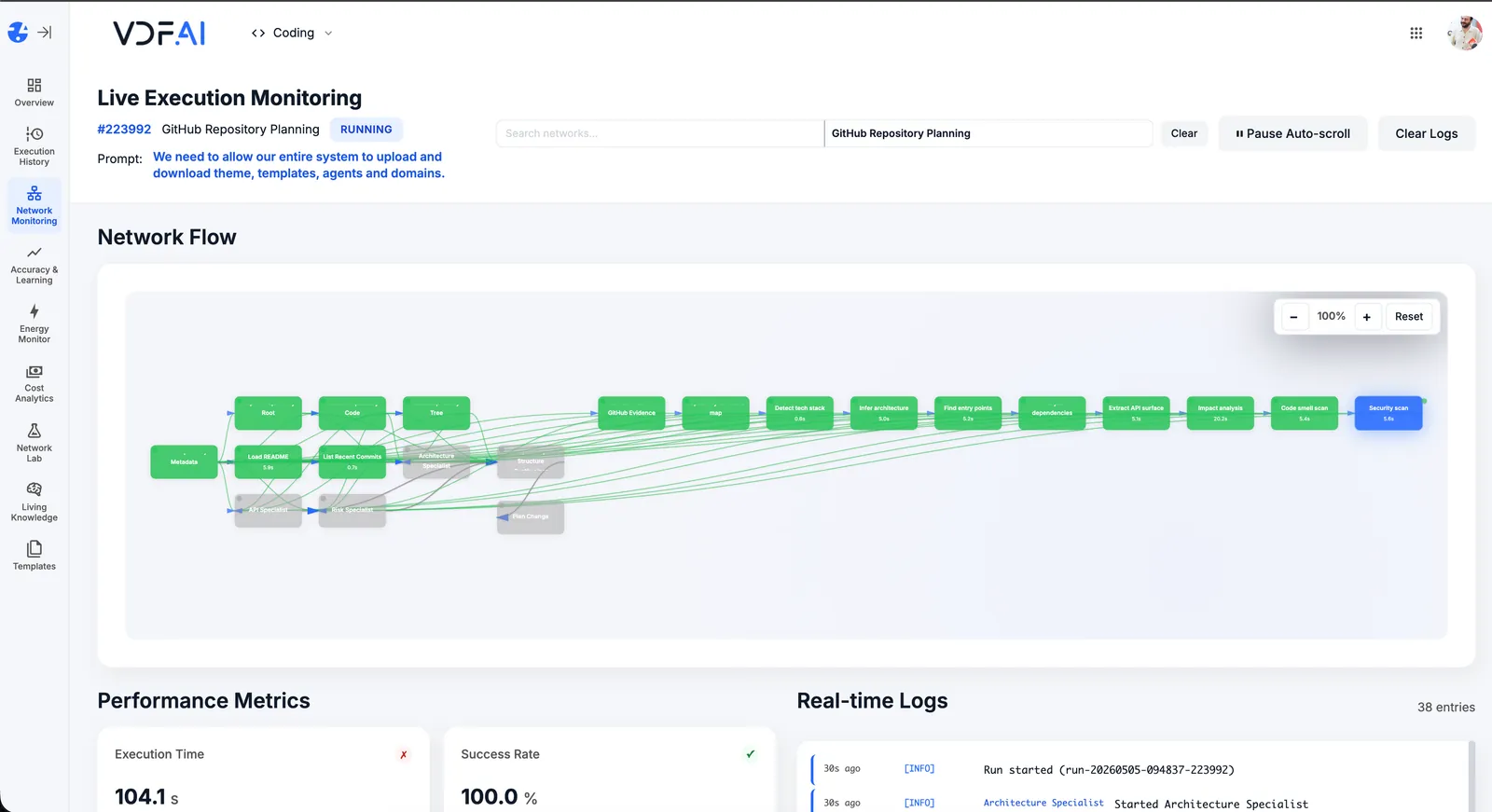
Engineering bottlenecks happen at review time. VDF AI ships code_review, pr_review_assistant, impact_analysis, security_scan, and the github MCP tool out of the box. Wire them into one Review Network and you have an autonomous senior reviewer.
The senior reviewer who spots the subtle race condition is in three other meetings. The public AI tools see the diff but not your codebase's context, your prior incidents, or your security posture. VDF AI gives you a reviewer that ingests your repo, calls GitHub natively, and reasons over the change with a model you control.
The problem
Senior reviewers are scarce
The reviewer who spots the subtle race condition is in three other meetings. Public AI tools see the diff but not your codebase's context, your prior incidents, or your security posture.
The VDF AI approach
A reviewer that knows your repo
VDF AI indexes your code into a vector store, calls GitHub directly, runs static heuristics, and reasons over the diff with a model you control — never sending source to the public.
WHY THIS MATTERS NOW
Code review is the bottleneck of velocity
Time-to-first-review is the most underrated metric in engineering. It correlates with morale, defect rate, and time-to-recovery. Most platforms attack it by training developers harder; VDF AI attacks it by giving every PR a tireless co-reviewer that knows your repo, your prior fixes, and your security posture.
The Review Network composes built-in MCP tools — code_review, pr_review_assistant, security_scan, impact_analysis, code_smell_detector, github — with a GitHub vector store. SEEMR routes complex diffs to your strongest private model and routine doc-only PRs to a small SLM.
WHAT YOU NEED TO START
Prerequisites for a pilot
Source & signals
- GitHub or GitHub Enterprise org
- CI logs for impact context
- Prior incidents archive
- Security policy documents
Models & tools
- Registered private model for reasoning
- Optional: small SLM for triage
- Webhook endpoint for PR events
- Per-repo domain configuration
People
- One DevEx lead
- One security champion
- One SRE for tuning
- Optional: a tech-debt owner per repo
REFERENCE ARCHITECTURE
PR opens → full review in minutes
Webhook
Built-in MCP tools
github_vector_search
Intent: review-pr
PLAYBOOK · STEP BY STEP
Make the review pipeline autonomous
Index your repos with VDF Data
Build the GitHub vector store. Now github_vector_search can ground every review in surrounding code.
Compose the Review Network
Drop the built-in MCP tools onto the canvas. Bind them to an intent template named review-pr.
Hook the GitHub webhook
A small Custom HTTP tool consumes the PR event, calls the Network, and posts the response back as a PR comment.
Tune system prompts per repo
Use domains to keep service-specific norms (e.g., "this repo is regulated, flag any external dependency").
Watch quality compound
SEEMR learns which sub-task each model does best. Energy and cost per review drop quarter over quarter.
OUTCOMES
PR latency drops, quality holds
median time-to-first-review.
defects caught before merge in pilot repos.
source code sent to external SaaS providers.
SEEMR REFERENCE
Routing by code intent
Security-sensitive diffs get your high-capability private model. Doc-only changes get a small fast model. SEEMR picks based on diff signal.
FREQUENTLY ASKED QUESTIONS
What teams ask before shipping this playbook
Does this replace human reviewers?
No. It accelerates them. The agent posts comments and a risk score; humans decide to approve, request changes, or merge.
Can it learn from past review feedback?
Yes. SEEMR ingests "thumbs up" / dismissed signals from PR comments and tunes which sub-task each model is best at.
Will it leak source to a public model?
Not by default. Source-bearing prompts route only to models registered as private. Domain policy can disallow public-model routing entirely for code.
How does it handle monorepos?
Use per-service domains. The Network scopes retrieval and review focus to the service affected by the diff.
Can it open PRs itself?
Yes — for code-review fix suggestions, refactors, or dependency upgrades. Most teams gate that behind an explicit label or command.
How long to pilot?
Two to three weeks: one to vectorize the repo, one to tune prompts and routing, one to validate against past PRs.
RELATED PLAYBOOKS
Continue with related VDF AI patterns



GET IN TOUCH
You Have Questions
Tell us what you’re trying to achieve—governed AI Networks, enterprise RAG, deep integrations, or on‑premise deployment. We’ll help you map the right architecture, security posture, and rollout path. If you’re moving beyond AI pilots and need scalable, auditable execution, reach out—our team is ready to help.